The rise of the Pakistan aviation hub 2026 has become the defining story of a year marked by unprecedented global travel disruption. On February 28, 2026, the “high-capacity bridge” of the global aviation industry, the Gulf corridor, effectively collapsed. US-Israeli strikes on Iranian military targets triggered a cascade of emergency airspace closures across nine countries, including the UAE, Qatar, Saudi Arabia, and Iran. Almost overnight, the world’s most trafficked long-haul routes between Europe and Asia were severed.
The scale of this shift is immense. In the initial weeks, over 27,000 flights were canceled, and roughly 90,000 passengers were stranded daily. Megahubs like Dubai and Doha, which once funneled tens of millions of travelers between continents, were forced to operate at a fraction of their capacity.
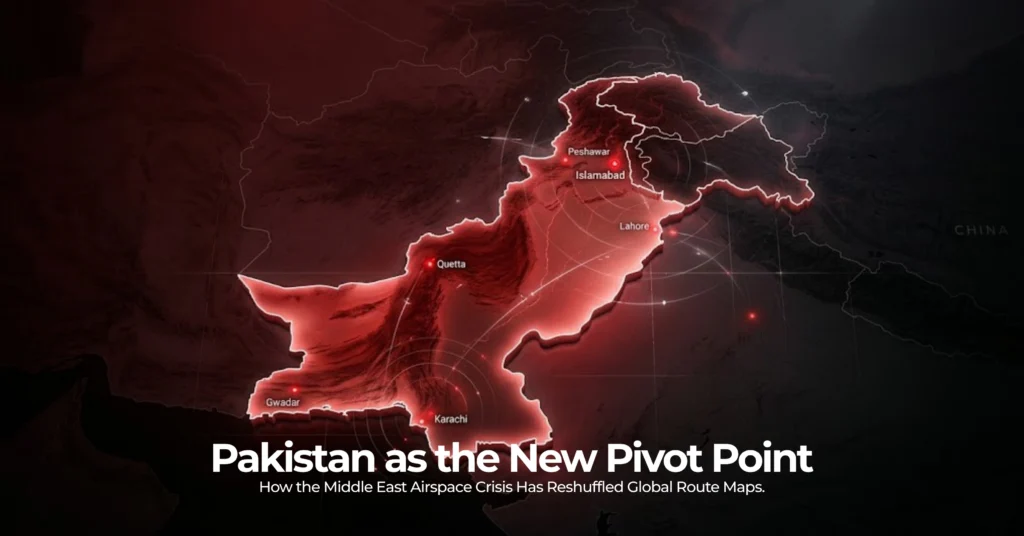
Today, global aviation is navigating a reshuffled map. Two primary bypass corridors have emerged: the Northern Bypass via Turkey and Afghanistan, and the Southern Bypass via Egypt and Oman. As these corridors converge, Jinnah International Airport (OPKC) has moved from the periphery to the center of global flight planning. For airlines and operators, the Pakistan aviation hub 2026 is no longer a future concept; it is a present-day operational necessity.
The Emergence of the Pakistan Aviation Hub 2026
The Bridge That Broke
For decades, the Gulf megahub model functioned like a six-lane motorway. Dubai, Doha, and Abu Dhabi acted as a singular interconnected super-corridor, providing the most efficient path between Europe, Africa, and Asia. When regional tensions boiled over on February 28, every lane of that motorway closed simultaneously.
The impact was immediate. Dubai International (DXB) canceled over 1,000 flights on day one, while Bahrain International (OBBI) ceased operations indefinitely. The traffic didn’t disappear; it simply began looking for the service road.
The Scale of Disruption
- Capacity Crunch: Over 15,000 flights were canceled within the first 14 days of the crisis.
- Rising Costs: Airfares on alternative routes spiked 15–25% as carriers grappled with longer flight times.
- Fuel and Time: Journey times between Europe and Asia have extended by 4 to 6 hours, placing an immense strain on fuel reserves and crew duty limits.
- Logistics Lag: The loss of belly cargo capacity on canceled Gulf flights has disrupted global supply chains.
The Two Alternate Corridors;And Where They Lead
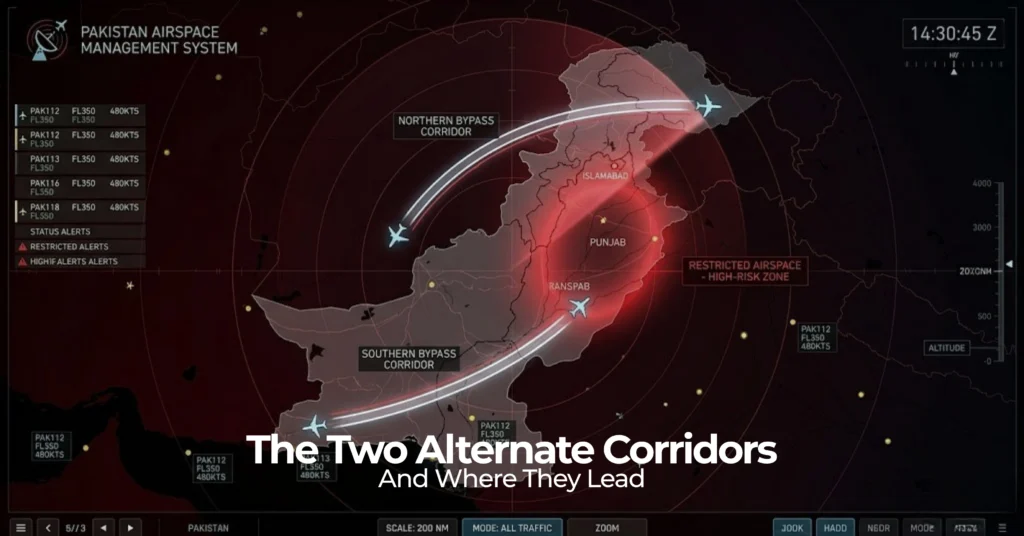
Northern Bypass: Caucasus → Afghanistan
Airlines routing north are utilizing a path through Turkey, Armenia/Azerbaijan, and the Kabul FIR (OAKX). However, this corridor is narrow. With European and US carriers still banned from Russian airspace due to Ukraine-related sanctions, traffic is squeezed into a thin viable band between two conflict zones.
Southern Bypass: Egypt → Saudi → Oman
The southern route runs through Egypt (HECC) and contingency segments of Saudi Arabian airspace (OEJD) before exiting through Oman (OOMM). While functional, this route is fuel-intensive and prone to GNSS interference, requiring precise navigation and extra reserves.
The Convergence Point
Whether an aircraft takes the Northern or Southern bypass, the flight paths eventually funnel toward the same entry point into South Asia. Geography dictates the solution: Pakistan. The Karachi FIR (OPKR) and Jinnah International Airport (OPKC) sit at the precise junction where these flows meet before descending into Southeast Asia or Australasia.
Why OPKC is the Center of the Pakistan Aviation Hub 2026
Geography That Cannot Be Replicated
OPKC sits at 24°N, directly on the southernmost viable routing arc between the bypass corridors and major Asian markets. It is the natural first landing option for aircraft exiting the Oman corridor or entering from the Afghan FIR. Unlike other regional airports, Karachi offers unobstructed coastal approach paths and a terrain-free environment, making it the ideal Karachi diversion hub.
Technical Stop Capability
For ultra-long-haul sectors that have added 6 hours to their flight plan, Karachi airport technical stop services provide a vital relief valve:
- Advanced Infrastructure: On February 19, 2026, OPKC completed a major upgrade to its central runway (25R), making it fully capable of handling wide-body aircraft, including the Airbus A380.
- Engineering Excellence: The airport features the Ispahani Hangar, offering MRO and engineering support for wide-body fleets.
- 24/7 Fueling: Competitive fueling rates and high-speed delivery systems ensure quick turnarounds.
The Aeroworld Karachi Flight Support Vantage Point
Aeroworld has operated out of Jinnah International’s Cargo Complex since 2012. In a crisis where NOTAMs change hourly, local expertise is the difference between a seamless technical stop and a costly ground delay. Our deep relationships with handling agents, customs, and slot coordinators provide an operational asset that remote dispatch centers simply cannot replicate.
What This Means for Operators: 5 Practical Realities
- Old Flight Plans are Obsolete: Fuel calculations based on Gulf overflight no longer apply. Every route between Europe and Southeast Asia requires a fresh assessment of the Pakistan airspace corridor.
- Crew Duty is the New Bottleneck: The 4–6 hour increase in flight time means crew duty limits are being hit more frequently. Planned technical stops at a well-equipped airport like OPKC are now mission-critical.
- Permit Volatility: The Northern route involves the Afghanistan FIR, requiring specific overflight permits. OPKC trip support services are essential for managing these daily-changing requirements.
- Pre-Filed Diversions: Flying over the Arabian Sea without a pre-arranged diversion plan at Karachi is a significant risk. Having OPKC flight support on standby ensures you aren’t fighting for ramp space during an emergency.
- Commercial Opportunity: Pakistan is no longer just a “bypass.” With a large diaspora and growing business travel, it represents a viable scheduled destination for carriers redesigning their network architectures.
Setting Up OPKC as a Support Base: A Practical Checklist
- Step 1: Assess Exposure. Identify routes previously transiting the Gulf and map them against Karachi’s 24°N coordinates.
- Step 2: Pre-File Permits. Ensure your Pakistan FIR overflight and landing permits are current. Ad-hoc requests during peak traffic can face delays.
- Step 3: Secure Fueling Contracts. Establish arrangements at OPKC to ensure priority service and transparent pricing.
- Step 4: Educate Dispatch Teams. Ensure your operations team understands the recent runway upgrades and wide-body capabilities at OPKC.
- Step 5: Connect with Local Support. Partner with a 24/7 provider like Aeroworld that has a physical presence at the station.
Frequently Asked Questions
Is Pakistan airspace currently open and safe?
Yes. In March 2026, the Pakistan Airports Authority (PAA) confirmed that airspace remains fully open and available. While certain altitude-based advisories exist (standard for regional risk management), commercial overflights are operating normally.
What are the runway capabilities at OPKC?
OPKC features two concrete runways. The central runway was upgraded in February 2026 to handle the largest commercial aircraft, including A380s and B747-8s.
How quickly can Aeroworld arrange a technical stop?
With our 24/7 ops center at Jinnah International, we can facilitate permits and ground handling in a matter of hours for planned stops and provide immediate support for diversions.
Conclusion
The Gulf airspace collapse of 2026 is not a temporary shock; it is a structural shift in how the world flies. For the remainder of the year and beyond, the Pakistan pivot will define the efficiency of the Europe-Asia corridor.
Jinnah International Airport (OPKC) stands ready as the premier technical stop and diversion hub for this new era. Aeroworld’s decade of experience on the ground ensures that when your flight plan meets reality, you have a partner who knows every inch of the ramp.
If your routes cross the new bypass geography, contact Aeroworld’s 24/7 team at ops@aeroworld.pk to secure your operations in the new global pivot point.