Geopolitics rerouting global flights 2026 is no longer an exceptional disruption — it is the persistent operational environment that every long-haul charter, cargo, and VIP operator now plans within, whether they acknowledge it or not.
In early 2026, Dubai, Doha, and Abu Dhabi went offline simultaneously. Iranian airspace closed. Israeli airspace became subject to active restrictions. The Gulf, the most transited aviation corridor on the planet, contracted without warning. Operators holding standard Gulf-routing flight plans suddenly held permits for airspace they could no longer use, and needed new permits for routes they had never filed before. The operators who managed the disruption were the ones whose permit infrastructure moved as fast as the geopolitical situation did. The ones who did not were grounded — not by the conflict, but by the permits they had not prepared.
This blog maps the current disruption landscape, explains the mechanical relationship between geopolitical events and permit requirements, and gives operators a framework for staying ahead of the next disruption before it happens.
Operational warning: Geopolitical airspace closures invalidate existing permits immediately. If your routing passes through any conflict-advisory region, confirmed contingency permits for an alternative corridor must be in place before departure — not arranged after the closure is announced.
The Three Disruption Events That Have Permanently Changed Global Routing
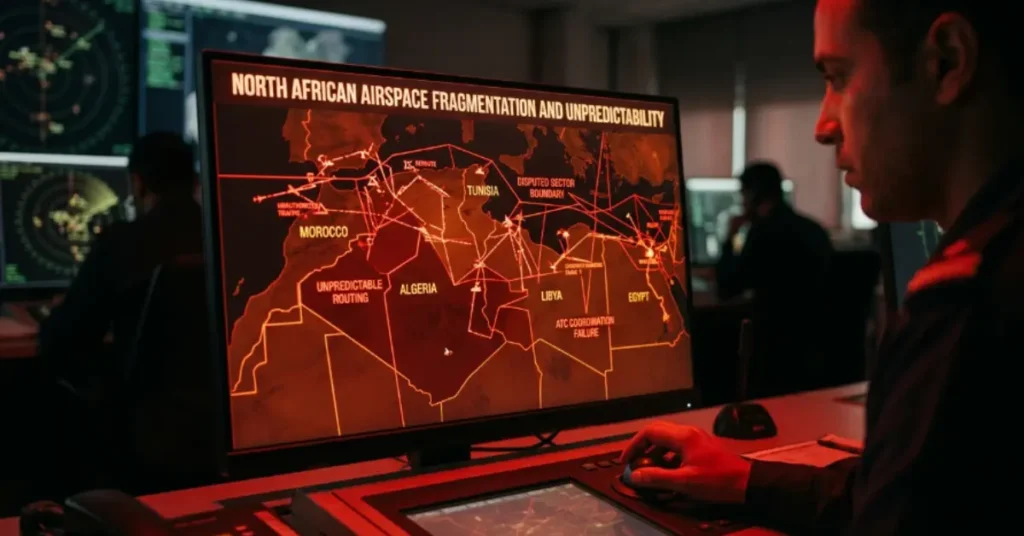
1. Russian and Ukrainian Airspace: The Closure That Restructured Europe-Asia Routing
Russian airspace has been closed to Western-registered and Western-operated aircraft since February 2022. This is not a temporary situation — it is a permanent operational baseline against which all Europe-to-Asia routing must now be planned, indefinitely.
The practical effect is significant for operators who have not yet normalised the change. Routes from Europe to East Asia that previously transited Russian airspace now route south through Central Asian corridors, over the Middle East, or via polar alternatives. Sectors that were 10 to 11 hours are now 13 to 15 hours. Additional fuel stops are required, which means additional permit sets covering Kazakhstan, Uzbekistan, and Turkmenistan — states that most European charter and cargo operators had never previously needed permits from.
EUROCONTROL’s Network Manager has documented the scale of this network restructuring in detail. The volume of rerouted traffic through Central Asian airspace since 2022 has fundamentally altered the permit workload for any operator on Europe-Asia sectors, and that workload is now permanent, not transitional.
For operators whose routing involves any refuelling on these alternative corridors, the interaction between fuel stop planning and permit requirements becomes critical. Aeroworld’s fuel uplift planning guide for long-haul charters covers how fuel stop decisions must be made with the permit set in view — a fuel stop location that triggers a difficult or slow permit process must be identified at the planning stage, not after it is committed to in the routing.
2. Gulf Corridor Disruption: The 2026 Event and Its Lasting Implications
The Iran-US-Israel conflict escalation of early 2026 triggered simultaneous airspace restrictions across Iranian airspace, temporary closures at Dubai, Doha, and Abu Dhabi, and active conflict-zone advisories across parts of the Gulf corridor. The acute event has passed. The operational lessons it produced have not.
Even as Gulf hubs reopened, operators restructured their planning. They built in alternate routings, secured permits for contingency corridors they had previously ignored, and stopped treating Gulf-transit as guaranteed. The operators who adapted fastest were those who already had permit infrastructure in place for alternative corridors before the disruption began.
Pakistan’s elevation as a primary contingency corridor was one of the most operationally significant developments of the period. With Gulf routing under pressure, Pakistan’s airspace — specifically the Karachi FIR — absorbed substantially increased traffic from operators rerouting south of the conflict zone. Aeroworld’s Pakistan Airspace Operational Guide 2026 covers the dual FIR structure, permit requirements, and the specific routing characteristics of that corridor for international operators.
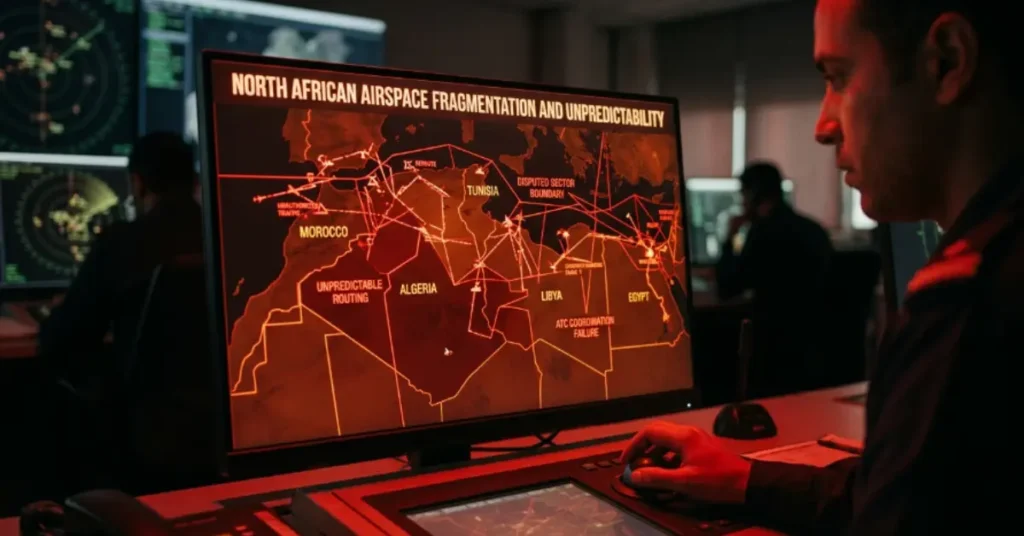
3. North African Airspace: Fragmentation That Requires Individual Station Intelligence
Libyan airspace remains operationally divided. Different zones are controlled by different authorities, permit requirements vary by zone, and military activity creates unpredictable temporary restrictions. A blanket Libya overflight permit does not cover all zones. Every permit application must specify the exact routing zone — and a permit secured for the wrong zone does not protect the operator once the aircraft is airborne.
Sudan’s civil conflict has added a further restriction zone to the East Africa-Europe corridor, with both EASA’s conflict zone information service and ICAO’s conflict zone guidance framework flagging Sudanese airspace for elevated risk assessment requirements. The combined effect on Africa-Europe routing is that operators who previously used relatively direct North African paths now require more complex permit sets and must build alternate routing provisions into every plan from the outset.
How Geopolitical Disruptions Create Permit Complexity: The Mechanics
Every New Airspace Segment Is a New Permit Application
The connection between geopolitical rerouting and permit requirements is mechanical, not procedural. Understanding the mechanics is what separates operators who adapt quickly from those who discover the problem at the FIR boundary.
When a route is rerouted around a conflict zone, it enters airspace that was not on the original permit application. Every new sovereign airspace segment requires its own permit from the specific national Civil Aviation Authority of the country whose airspace is now being transited. An operator who reroutes from a Gulf corridor to a Central Asian corridor has not just changed a line on the map. They have changed their entire permit set — potentially from three or four permits to six or eight, across authorities they may never have dealt with before.
Lead times do not compress because the geopolitical situation moves fast. A conflict-driven airspace closure happens overnight. The permit processing time for the new routing does not. Some Central Asian and African CAAs that operators now need permits from require five to seven working days under normal conditions — and normal conditions do not apply when every operator across the industry is rerouting simultaneously, submitting applications to the same authorities at the same time.
Conflict Zone Advisories Are Not the Same as Airspace Closures
This distinction is operationally critical and must be treated as such in every trip planning cycle.
An airspace closure is a prohibition. The airspace is not available to foreign aircraft regardless of operator preference. For closures, the action is clear: reroute and obtain new permits.
A conflict zone advisory is a risk notification. The airspace is technically accessible, but EASA and ICAO have identified elevated risk to civil aviation operations within it. For advisories, the operator must conduct a documented risk assessment, confirm insurance coverage under conflict zone conditions, notify crew, and make a conscious operational decision about whether to transit. Flying through advisory airspace without this documented process is a compliance failure even if ATC clears the routing — the insurance and safety management obligations sit alongside the ATC permission, not beneath it.
Permit Amendments Versus New Applications
If a route change occurs after permits have been submitted but before departure, the question is whether an amendment to the existing permit covers the new routing or whether a new application is required. The answer varies by country. Some CAAs accept route amendments within the validity window; others require a complete new application regardless of how minor the change is.
Operators who do not know which regime applies to each country in their routing risk assuming an amendment covers them when it does not. Aeroworld’s overflight permit consequences guide covers what happens at the FIR boundary when a permit does not match the filed plan — including the specific failure modes that most commonly result from route changes made after initial permit submission.
Planning note: For any routing that passes through or adjacent to a geopolitically active region, contingency permit applications for the alternative corridor should be submitted simultaneously with the primary routing permits — not after the primary permits are confirmed.
The Central Asian Corridor: Permit Requirements Operators Must Have in Place
Kazakhstan, Uzbekistan, and Turkmenistan: Three Different CAAs, Three Different Processes
The Central Asian corridor is the primary replacement for Russian airspace on Europe-East Asia routes. All three states require individual overflight permits from their national CAAs, and experience with one does not transfer directly to the others.
| State | Typical Processing Time | Key Considerations |
|---|
| Kazakhstan (CAC) | 48–72 hours | Well-established process; high traffic volume since 2022; stable documentation requirements |
| Uzbekistan | 48–72 hours | Similar timelines to Kazakhstan but different documentation requirements; confirm individually |
| Turkmenistan | 5+ working days | Most operationally challenging; variable responsiveness; missing this permit invalidates the entire routing |
All three states require confirmed permits before ATC will accept the routing at the FIR entry point. Arriving at the boundary without confirmed permits is not a situation ATC can resolve — it is a grounding event.
The Southern Corridor via Turkey and the Caucasus
Turkish airspace, handled through DHMI across the Ankara and Istanbul FIRs, is well-served for standard charter operations. Georgia and Azerbaijan airspace both require individual permits and both have established processes. Operators routing through both simultaneously must manage two separate authority interactions and must not assume that approval from one implies anything about processing at the other.
When Polar Routing Is an Option
For ultra-long-range aircraft with sufficient range to avoid both Russian airspace and the southern detour, polar routing via the North Pole remains available. It requires specific cold-weather alternate airport planning and ETOPS authorisation for twin-engine operations. For operators with the right aircraft and approvals, it eliminates Central Asian permit complexity entirely — but it is not a practical option for most charter and cargo operations.
The Gulf Corridor: What Operators Need Now the Dust Has Settled
Iranian Airspace: The Persistent Variable
Iranian airspace has been the most operationally volatile element of Gulf routing for years. The 2026 escalation accelerated a trend that was already underway — operators are now building routes that do not depend on Iranian airspace availability, even when it is technically open. Permits for Iranian transit require documentation from Iran’s Civil Aviation Organization. Lead times are 48 to 72 hours under normal conditions but have historically extended during periods of political tension — exactly the conditions under which an operator most urgently needs a confirmed permit.
The operational standard for 2026: obtain Iranian overflight permits as planned for the primary routing, and maintain a confirmed contingency routing with its own complete permit set before departure. Holding both is now the baseline, not the precaution.
Pakistan’s Karachi FIR: The Contingency Corridor That Became Standard Practice
The Gulf disruption of early 2026 established Pakistan’s Karachi FIR as the primary contingency corridor for operators avoiding Gulf airspace. Operators who discovered this option during the disruption spent days scrambling for permits they had never needed. Operators who had Pakistan permits pre-positioned as a contingency managed the reroute in hours.
For operators whose routing passes through or near the Gulf, Pakistan contingency permits should be treated as a standard element of every trip plan — not an exceptional measure for exceptional circumstances. Aeroworld’s Pakistan Airspace Operational Guide 2026 covers the dual FIR structure, permit requirements, and ground coordination in detail.
North African Airspace: The Corridor That Requires Individual Assessment
| Region | Current Status | What Operators Must Do |
|---|
| Libya | Operationally fragmented; zone-specific authority | Specify exact routing zone in every application; blanket permit not sufficient |
| Sudan | Active EASA and ICAO conflict zone advisories | Documented risk assessment required; treat as elevated-risk, not standard permit |
| Egypt and Sinai | Standing conflict zone advisory for specific altitude band | Check specific routing against advisory zone; not all Egyptian airspace affected |
For operators whose Africa-Europe routing previously ran through relatively direct North African paths, the current requirement is a more complex permit set, individually assessed for each zone, with alternate routing provisions built into every plan before departure.
Aeroworld’s operational presence through its Tripoli office provides real-time airspace intelligence for the Libyan corridor that remote handlers working from standard NOTAM databases cannot replicate. For any operator planning a routing through North African corridors, this difference in intelligence quality is not a marginal advantage — it is operationally significant.
The Practical Framework: Permits for the Route You Might Need to Fly
The operational approach that the 2026 disruption environment demands is a shift from reactive to proactive permit management. The following framework applies to every long-haul international sector that passes through or adjacent to geopolitically active airspace.
Step 1: Map geopolitical exposure before routing is confirmed. Before the routing is filed, identify every sovereign airspace segment that carries geopolitical risk — active conflict, elevated tension, historical disruption pattern, or EASA/ICAO conflict zone advisory. This is a pre-departure check on every trip, updated against current intelligence. An airspace that was stable last month may carry an advisory today.
Step 2: Build contingency routing and obtain contingency permits. For every geopolitically exposed segment, identify an alternative routing that avoids it entirely and obtain confirmed permits for that alternative before the primary routing is filed. A confirmed contingency permit set costs a fraction of what a grounded aircraft costs while permits are being arranged under pressure.
Step 3: Apply the longest lead time to the entire planning timeline. A six-country routing where five states process in 48 hours and one requires seven working days must be planned on the seven-day timeline. In geopolitically disrupted environments, add buffer beyond the stated minimum — authorities handling multiple simultaneous reroute applications from operators across the industry move slower, not faster.
Step 4: Monitor against real-time intelligence, not just filed NOTAMs. NOTAMs capture formalised airspace changes. Geopolitical developments that have not yet been translated into NOTAMs can still affect whether transiting a specific airspace is operationally prudent. EASA conflict zone bulletins, ICAO advisories, and real-time intelligence from operators with on-the-ground presence in affected regions are the sources that matter alongside the formal NOTAM database.
Step 5: Never assume a permit obtained under normal conditions covers a disrupted environment. A permit for a standard Iranian overflight obtained during a period of stability may still be technically valid during a period of elevated tension — but operating on it without an updated risk assessment is an operational decision the operator must make consciously, not by default. The permit does not substitute for the risk assessment.
Step 6: Integrate permit management with flight planning, not after it. Routing decisions and permit applications must happen simultaneously. A routing decision made without permit lead time awareness is a plan that may not be executable. Aeroworld’s integrated flight planning and permit management service is built specifically to eliminate this gap — the routing is built with the permit set in view from the first draft.
For operators who need a comprehensive understanding of what a robust flight plan looks like when built correctly, Aeroworld’s step-by-step international charter flight plan guide covers the integration of permit cross-referencing into routing construction at every stage.
Ready to operate with certainty through geopolitically complex airspace? Aeroworld’s permit team monitors the situation in real time and pre-positions contingency permits as a standard element of every complex trip plan. Contact our ops team at aeroworld.pk or reach us 24/7 at +92 315 6666772.
How Aeroworld Operates in Geopolitically Disrupted Environments
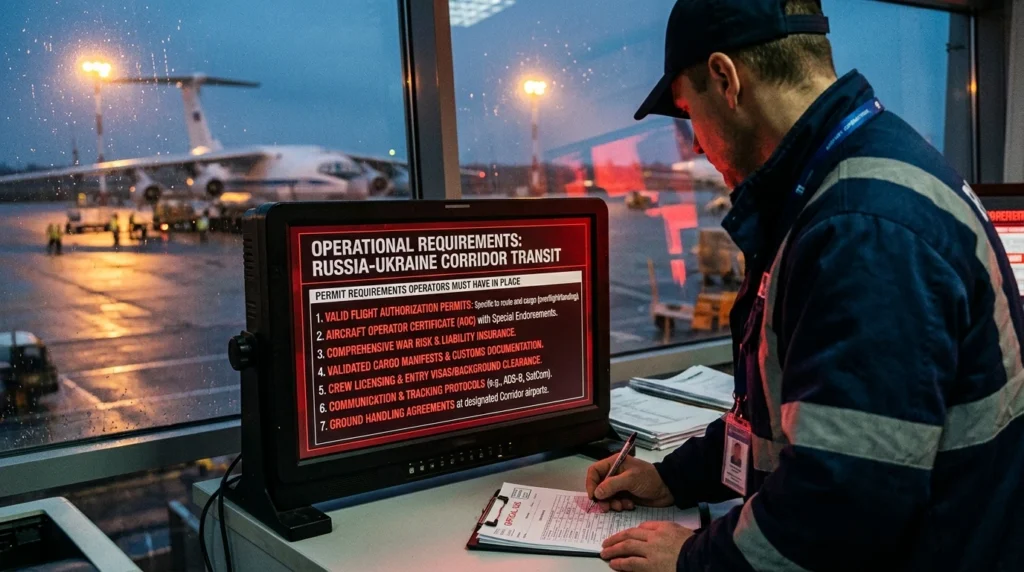
Aeroworld’s operational capability is built for the environment described in this blog — not for the stable, predictable routing environment that no longer exists on most long-haul international sectors.
Real-time airspace intelligence. The operations team monitors geopolitical developments and their airspace implications continuously, tracking EASA conflict zone bulletins, ICAO advisories, and on-the-ground intelligence from Aeroworld’s network across Pakistan, Libya, Gambia, and the broader EMEA region. When a situation develops, operators working through Aeroworld receive a routing and permit assessment in real time, not hours later.
Established relationships in alternative corridors. The Central Asian permit landscape, Pakistan’s dual FIR structure, and North African permit complexity are not unfamiliar territory — they are corridors Aeroworld’s permit team navigates daily. Working relationships with CAAs in Kazakhstan, Pakistan, Libya, and Turkey are established and active, not cold applications submitted during a crisis when every other operator is submitting simultaneously.
Contingency permits as standard practice. Aeroworld arranges contingency permit sets for alternative corridors as a standard element of trip planning — giving operators a confirmed backup routing before the primary routing is threatened. This became visible as an operational standard during the 2026 Gulf disruption. It is now a standing feature of how Aeroworld plans every trip through geopolitically exposed corridors.
Integrated routing and permit function. Because Aeroworld manages flight planning and permits as a single integrated function, a routing change triggered by a geopolitical event is handled as a coordinated update. New routing filed, new permits applied for, fuel calculations adjusted, and alternates confirmed simultaneously — not sequentially. For more on how this integration works in practice, Aeroworld’s smart permit management approach covers the digital tracking and proactive authority coordination that makes real-time permit management possible.
24/7 coverage for 24/7 geopolitics. Geopolitical events do not observe business hours. Aeroworld’s operations team is live around the clock, so when a situation develops overnight, operators have a team already working on the solution.
As Aeroworld’s ground handler checklist for international operators establishes, permit management is just one element of the integrated pre-arrival coordination that makes international operations reliable — every element of the operation must be confirmed, not assumed, before the aircraft moves.
Frequently Asked Questions
Q1: Which airspace regions carry the highest geopolitical risk for operators in 2026?
The highest-risk regions in 2026 are Russian airspace (closed to Western-registered aircraft), Iranian airspace (operationally volatile with variable permit processing during periods of tension), Sudanese airspace (active EASA and ICAO conflict zone advisories), Libyan airspace (operationally fragmented with zone-specific permit requirements), and parts of the Sinai Peninsula (standing conflict zone advisory for a specific altitude band). The Gulf corridor carries residual risk following the 2026 disruption event even as major hubs have reopened. For any operator whose routing passes through or adjacent to these regions, contingency permits for an alternative corridor should be confirmed before every departure — not treated as exceptional provision for exceptional circumstances.
Q2: Does a geopolitical airspace closure automatically invalidate permits already obtained for that route?
Yes. A sovereign state airspace closure — whether due to conflict, political decision, or military operation — immediately supersedes any existing permit for that airspace. A permit is authorisation to enter a specific airspace under normal conditions; it does not override a state’s decision to close its airspace to foreign aircraft. Operators holding permits for airspace that subsequently closes must treat those permits as void for the duration of the closure and apply for permits on their alternative routing. Whether original permits are refundable depends on the issuing authority’s policy, which varies significantly by state. This position should be clarified at the time of application, not after a disruption event forces the issue.
Q3: What is the difference between a conflict zone advisory and an airspace closure, and what must operators do differently for each?
An airspace closure is a prohibition — the airspace is not available to foreign aircraft regardless of operator preference. A conflict zone advisory is a risk notification — the airspace is technically accessible but EASA or ICAO has identified elevated risk. For closures: reroute and obtain new permits. For advisories: conduct and document a risk assessment per ICAO Doc 10084, confirm insurance coverage under conflict zone conditions, notify the crew, and make a conscious documented decision about transiting. Flying through advisory airspace without this process is a compliance failure even if ATC clears the routing — the risk assessment obligation exists alongside the ATC permission, not beneath it.
Q4: What permits are required to route through Central Asian airspace as an alternative to Russian airspace?
Each Central Asian state requires its own overflight permit from its national CAA. Kazakhstan, Uzbekistan, and Turkmenistan are the three most commonly transited states on Europe-East Asia alternative routing. Kazakhstan and Uzbekistan typically process in 48 to 72 hours. Turkmenistan regularly requires five or more working days and has historically variable responsiveness — operators consistently underestimate Turkmenistan’s lead time, and a missing Turkmenistan permit invalidates the entire Central Asian routing. Operators should not assume that familiarity with one Central Asian CAA transfers to others, as documentation frameworks and processing behaviours differ in meaningful ways. All permits must be confirmed before the aircraft approaches the FIR entry point — arriving without confirmed permits is a grounding event, not a negotiating position.
Q5: How should operators build contingency routing for Gulf-transiting flights in 2026?
Gulf-transiting flights in 2026 should be planned with a primary routing through the preferred corridor and a confirmed contingency routing that avoids Iranian airspace and Gulf hub dependencies simultaneously. The contingency routing — typically via Pakistan’s Karachi FIR or through the Arabian Sea corridor — should have its own complete permit set obtained before the primary routing departs. The additional cost of a contingency permit set is a small fraction of the cost of a grounded aircraft while permits are arranged under pressure during a live disruption event. For operators who transit the Gulf regularly, maintaining standing contingency permits for the Pakistan corridor is the operational standard that the 2026 disruption made impossible to ignore. Aeroworld’s Pakistan Airspace Operational Guide 2026 covers the permit requirements and FIR structure for that corridor in full.
Q6: What liability does an operator face for flying through conflict zone airspace without a risk assessment?
Operating through conflict-advisory airspace without a documented risk assessment creates exposure across multiple dimensions at once. Insurance policies — particularly war risk and liability coverage — typically require operators to demonstrate that known risks were assessed and mitigated. Flying without documentation of that assessment may give insurers grounds to contest claims arising from incidents in the affected airspace, regardless of the outcome of the flight. At the regulatory level, Air Operator Certificate obligations include safety risk management as a core component — flying into elevated-risk airspace without a risk assessment is potentially a regulatory compliance failure that can be reviewed by the operator’s competent authority after the fact. The risk assessment is not a bureaucratic exercise. It is the documented evidence that the operator exercised the judgement that ICAO Doc 10084 and the regulatory framework require.
Q7: How quickly can Aeroworld arrange permits for an alternative routing when a disruption occurs?
The speed of arrangement depends on the specific states involved and the lead time available. For established alternative corridors where Aeroworld has active working relationships — including Pakistan, Kazakhstan, Turkey, and Libya — the permit team can initiate applications and work escalation channels immediately when a disruption event occurs. For states with mandatory minimum processing times that cannot be compressed, Aeroworld’s approach is to have contingency permits pre-positioned before a disruption event occurs. Operators who have arranged contingency permit sets in advance with Aeroworld can activate an alternative routing within hours rather than days — and that is the operational difference between a contingency that actually works and one that exists only in a trip plan document.
Q8: Does geopolitics rerouting global flights in 2026 affect operators who only fly Gulf-Pakistan routes?
Yes, directly. The Gulf-Pakistan corridor was one of the most affected routes during the 2026 disruption event — Pakistani airspace absorbed significantly increased traffic from operators rerouting south of the Gulf conflict zone, which created its own permit and slot coordination pressures. For operators on this corridor specifically, the lesson of 2026 is that routing which previously felt stable and predictable can be disrupted from multiple directions simultaneously, and that the permit infrastructure for contingency corridors must be in place before the disruption occurs. Aeroworld’s permanent presence at Karachi’s Jinnah International Airport, combined with its Tripoli and Sharjah offices, means that the key nodes of the Gulf-Pakistan-North Africa network are covered by a team with established authority relationships at every station. For more on how the VIP charter service is managed across these corridors, Aeroworld’s operational model ensures permits, routing, and ground coordination are handled as a unified function.
Conclusion
The route you planned last month may not be the route you can fly today.
Geopolitics rerouting global flights in 2026 is the new operational baseline — not a temporary condition to be managed until stability returns. The three disruption events covered in this blog — Russian airspace closure, Gulf corridor disruption, and North African fragmentation — have permanently changed the routing options available, the permit sets required, and the planning timelines that must be respected.
Operators who treat permits as a one-time pre-departure task and routing as a fixed plan are exposed every time a new geopolitical development reshapes the airspace. Operators who treat permits as a continuous, intelligence-driven function that moves with the geopolitical environment can adapt without grounding. The framework in this blog is the operational minimum for any operator flying long-haul international routes in 2026.
Operating through geopolitically complex airspace and need a permit and routing partner who monitors the situation in real time? Aeroworld’s ops team is available 24/7. Contact us at aeroworld.pk or reach us directly at +92 315 6666772.
The information in this blog is provided for operational guidance purposes. Operators are responsible for conducting their own risk assessments and compliance checks for all airspace transited. Conflict zone advisories and airspace status can change without notice — always verify current status with the relevant CAA and NOTAM databases immediately before departure.