The aviation industry stands at a critical crossroads. While flight remains the lifeblood of global commerce and connection, its environmental footprint is under intense scrutiny. With a global commitment to reach net-zero emissions by 2050, the sector is looking toward a singular, powerful solution: Sustainable Aviation Fuel (SAF).
However, the transition from fossil-based kerosene to sustainable alternatives is not just a matter of chemistry it is a monumental challenge of economics, infrastructure, and international policy. Currently accounting for less than 0.1% of global jet fuel, SAF must scale rapidly to meet 65% of the industry’s needs within the next three decades. In this report, we break down the high costs, supply chain bottlenecks, and the next-generation technologies like Power-to-Liquid (PtL) that are essential for taking aviation into a carbon-neutral future.
The Indispensable Role of SAF in Net-Zero
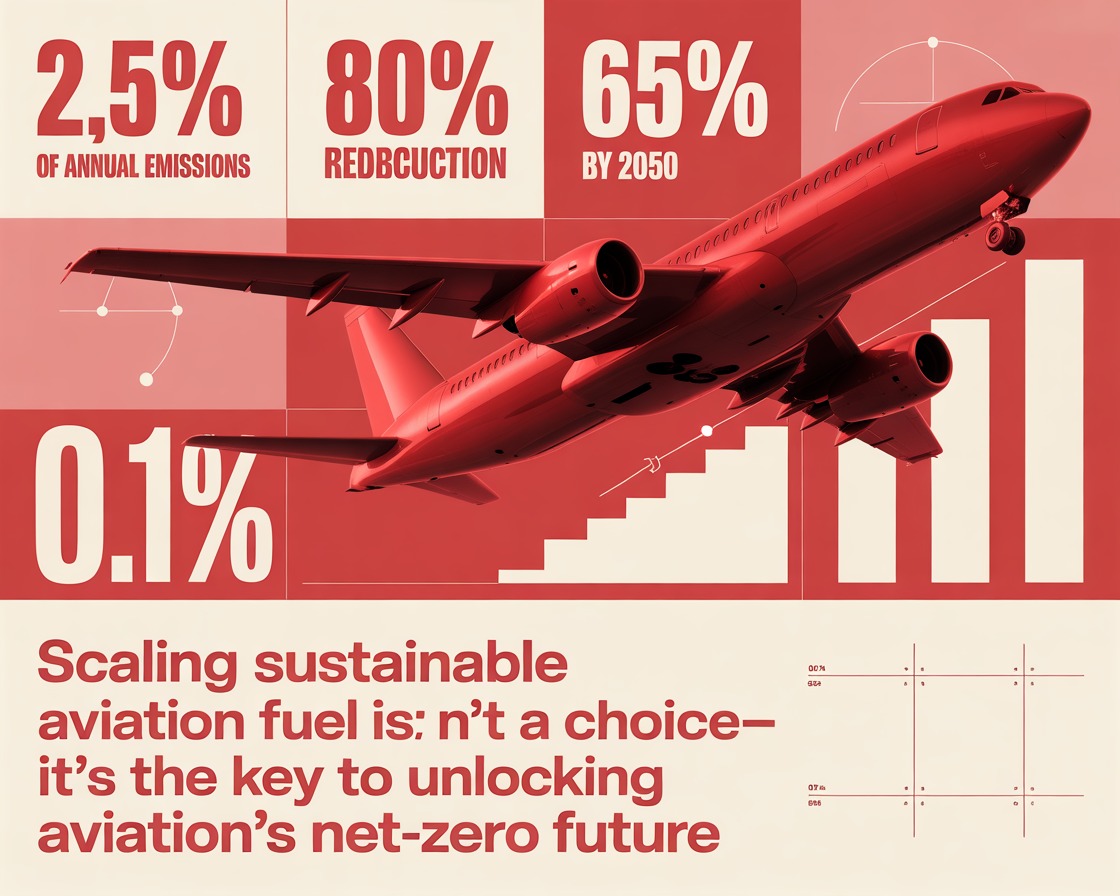
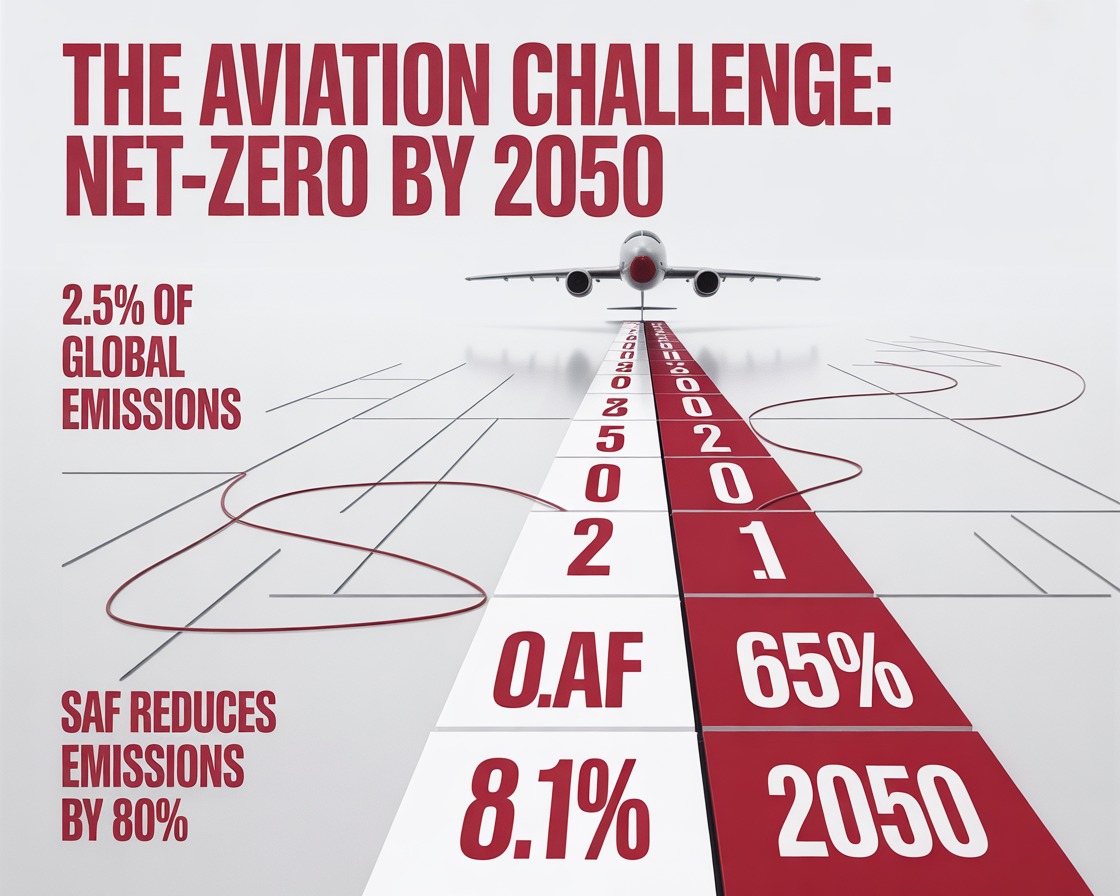
The global aviation sector, responsible for roughly 2.5% of annual global emissions, faces a formidable challenge: achieving net-zero emissions by 2050 [IATA, 2021 Resolution]. This ambitious target rests almost entirely on the shoulders of Sustainable Aviation Fuel (SAF).
The global aviation sector, responsible for roughly 2.5% of annual global emissions, faces a formidable challenge: achieving net-zero emissions by 2050 [IATA, 2021 Resolution]. This ambitious target rests almost entirely on the shoulders of Sustainable Aviation Fuel (SAF).
Despite its unequivocal promise, a significant gap persists between ambitious climate mandates and operational reality. While the industry needs Sustainable Aviation Fuel to constitute over 65% of its fuel mix by 2050, Sustainable Aviation Fuel Challenges currently accounts for less than 0.1% of global commercial jet fuel use [IATA, 2024 Market Data]. Global production capacity reached approximately 1 million metric tons in 2024 [ResourceWise, 2024 Report], marking impressive growth but still only covering a tiny fraction of demand.
Economic Barriers: High Cost and Investment Risk
The most immediate and profound constraint on Sustainable Aviation Fuel scaling is economic.
Prohibitive Cost Premium and Market Stalemate
SAF remains 2 to 5 times more expensive than conventional jet fuel [Argus Media, Price Analysis]. For airlines, where fuel already constitutes a staggering 20–30% of operating costs, this premium is prohibitive without regulatory intervention. In 2022, the average SAF price was estimated at around USD 2,400 per ton, roughly two and a half times the price of conventional jet fuel at the time [IATA, Economic Reports].
This cost differential has created a classic “chicken-and-egg” investment cycle: Producers need multibillion-dollar investments but cannot secure financing without long-term commitments; airlines cannot commit to multi-year contracts at current high prices.
Monetizing Carbon: The Role of Policy Intervention
Breaking this stalemate requires monetizing the carbon abatement value of SAF. Targeted policy mechanisms are essential:
- Blending Mandates: Regulatory requirements that create guaranteed demand, stabilizing the market.
- Tax Credits and Subsidies: Direct financial incentives, such as the Sustainable Aviation Fuel (SAF) Credit in the US Inflation Reduction Act (IRA), directly bridge the cost gap.
- Carbon Pricing Mechanisms: Mechanisms like the EU Emissions Trading System (EU ETS) assign a financial cost to fossil emissions, making SAF more competitive.
Verification Challenges in Book & Claim Systems
“Book & Claim” systems are emerging to simplify logistics and financial transfer. A carrier purchases the certified carbon reduction credit (the Book), while the fuel is physically used by a different carrier near the production site (the Claim). While this facilitates investment, it heightens complexity in verification and auditing to prevent double-counting.
Supply Chain Bottleneck: Feedstocks and Logistics
HEFA Dominance and the Feedstock Competition Crisis
- HEFA Dominance: The Hydroprocessed Esters and Fatty Acids (HEFA) pathway dominates current SAF production, accounting for over 90% of global SAF in 2024 [CENA, SAF-Outlook 2024]. It relies heavily on limited waste streams like used cooking oil (UCO) and animal fats.
- The Competition Crisis: Global UCO and tallow supplies are highly constrained and already in demand from the road biofuel sector, driving up feedstock prices [SkyNRG, Market Outlook].
- Sustainability Risks (ILUC): Over-leveraging waste streams risks Indirect Land-Use Change (ILUC). Robust sustainability criteria and certification (like CORSIA or ISCC) are crucial to prevent this.
Scaling Technology: The Shift to Next-Generation Fuels
Achieving the massive scale required by 2050 demands pivoting investment to next-generation technologies.
1. Power-to-Liquid (PtL): The Zero-Emission Goal
PtL is the ultimate goal, offering a path to nearly zero-emission fuel not constrained by biomass.
- Process: Combines Green Hydrogen (from renewable electricity) with Captured (from industrial sources or direct air capture).
- The Investment Hurdle: Requires massive infrastructure investment in renewable energy generation, hydrogen electrolysis, and capture facilities.
2. Other Scalable Pathways: AtJ and BtL
- Alcohol-to-Jet (AtJ): Converts ethanol or isobutanol into jet fuel. AtJ has the potential to reduce life-cycle emissions by up to 94% compared with traditional jet fuel [US DOE, AFDC].
- Biomass-to-Liquid (BtL): Converts solid biomass (agricultural or forestry residues) into liquid fuel via the Fischer-Tropsch (FT) process.
Policy Frameworks: US vs. EU Case Studies
The lack of a unified global policy framework is a major impediment.
The EU: Driving Compliance Market Demand (ReFuelEU)
The EU’s ReFuelEU Aviation initiative sets mandatory blending obligations for fuel suppliers.
The US: Supply-Side Stimulation (IRA Tax Credits)
The US approach, driven by the Inflation Reduction Act (IRA), focuses on supply-side stimulation through tax credits.
- The SAF Credit: The IRA provides a direct tax credit of $1.25 to $1.75 per gallon to producers based on lifecycle emissions reductions [IRS, Notice 2024-74], immediately closing the price gap.
- Goal: The SAF Grand Challenge aims to scale production to 3 billion gallons per year by 2030.
Conclusion: The Long Runway to Commercial Reality
Sustainable Aviation Fuel is the indispensable core of aviation’s net-zero future. The challenges of high cost, HEFA dependency, and logistical fragmentation are structural and interconnected.
The long-term viability of global flight hinges on the collective, decisive action taken now to finance and accelerate next-generation technologies.
Clear and stable regulatory frameworks must be globally harmonized to provide the investment certainty required to transform this costly, complex product into an essential commercial reality.
Frequently Asked Questions
What is Sustainable Aviation Fuel (SAF)?
Sustainable Aviation Fuel is a clean alternative to traditional fossil-based jet fuel. It is produced from renewable resources such as used cooking oil, agricultural waste, or even captured carbon and green hydrogen. Because it is a “drop-in” fuel, it can be blended with conventional kerosene and used in existing aircraft engines without any modifications.
Why is SAF Important for Net-Zero 2050?
Aviation is one of the “hard-to-abate” sectors because electric and hydrogen-powered planes are not yet viable for long-haul flight. Experts estimate that SAF will need to contribute around 65% of the total carbon reductions required for the industry to reach its goal of net-zero emissions by 2050.
Why is SAF So Expensive Compared to Regular Jet Fuel?
Currently, SAF is 2 to 5 times more expensive than conventional jet fuel. This is due to the limited availability of raw materials (feedstocks), the high cost of specialized production facilities, and the fact that the industry is still in its early stages without the benefit of large-scale production.
What is the Power-to-Liquid (PtL) Pathway?
Power-to-Liquid, often called e-fuel, is a next-generation technology that creates fuel by combining green hydrogen with captured carbon dioxide. Unlike bio-based fuels, PtL is not limited by the availability of waste oils or crops, making it the most scalable long-term solution for zero-emission flight.
How are Governments Helping Scale SAF Production?
Governments are using two main strategies: the EU uses “Blending Mandates” (ReFuelEU) to force a certain percentage of SAF use, while the US uses “Tax Credits” (Inflation Reduction Act) to make SAF production more profitable for companies. Both approaches aim to reduce the price gap and encourage investment.
Fueling the Future of Aviation!
Connect with Aeroworld to learn how we are supporting the transition to Sustainable Aviation Fuel (SAF) and driving net-zero goals.
Consult Our Experts