In the global aviation arena of 2025, securing overflight and landing permits has evolved from a back-office administrative task into a high-stakes strategic capability. The landscape has shifted dramatically; geopolitical volatility, surging traffic demands, and a fragmented digital transition among Civil Aviation Authorities (CAAs) mean that “business as usual” is no longer enough. Successful operators today are those who can blend regulatory mastery with real-time digital automation.
At Aeroworld, we act as your regulatory guardian. We understand that in a world of shifting bilateral agreements and heightened environmental mandates, red tape can quickly become a barrier to revenue. Our mission is to translate this complexity into execution utilizing predictive analytics, local agent networks, and 24/7 global support to turn potential disruptions into seamless runway time.
Navigating the Skies: How Smart Permit Management Is Powering Global Aviation in 2025

In the high-stakes world of global operations, securing overflight and landing permits is no longer a back-office bureaucratic exercise, it is a strategic capability. In 2025, successful operators are those who can combine regulatory mastery, digital automation, and real-time coordination to stay ahead of delays, denials, and disruptions.
At Aeroworld, we position ourselves as your regulatory guardian: translating complexity into execution, turning red tape into runway time, and safeguarding your schedule.
Why Permit Complexity Has Spiked Since 2020
- Elevated safety, security & environmental demands
Many civil aviation authorities have introduced new documentation, validation, and compliance checks in reaction to post-pandemic risk profiles and environmental regulations.
- Geopolitical shifts and airspace volatility
Airspace closures, diplomatic sensitivities, and shifting bilateral agreements mean that route approvals can be rescinded or modified with little notice.
- Fragmented digital maturity among CAAs
Some authorities now have full e-permit systems, others remain paper based or semi manual creating inconsistent pathways and surprises for operators.
- Surging demand, limited resources
Traffic growth and constrained CAA resources lead to permit backlogs, particularly for charter or non routine flights.
- Heightened data & analytics expectations
Authorities expect more pre submitted data: crew records, emissions, alternate routing, security clearances, etc. Incomplete or inconsistent data often triggers rejection or delay.
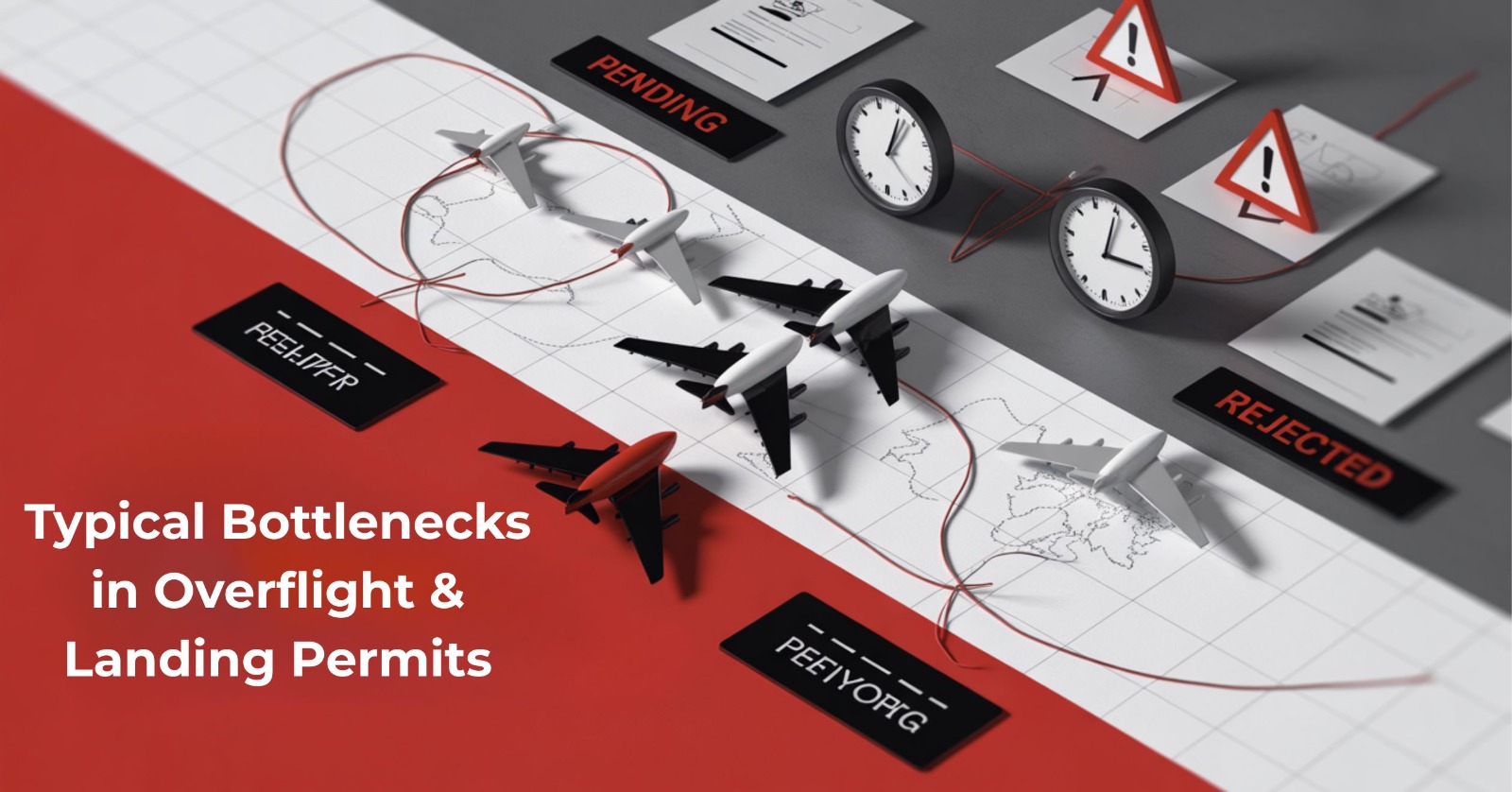
Typical Bottlenecks in Overflight & Landing Permits
- Inaccurate lead time forecasting
Operators often underestimate the time required, particularly when applications span multiple jurisdictions.
- Documentation gaps or non-compliance
Missing or invalid crew licenses, insurance, maintenance logs, noise certificates, or local attachments frequently derail an application.
- Regulation changes mid-process
Authorities may add last-minute requirements (e.g. biosecurity, health, fuel data) that were not disclosed initially.
- Lack of visibility and status tracking
Many operators don’t have a central view across all ongoing permit applications, making it hard to identify bottlenecks or follow up.
- Disconnect with ground operations / customs / slots
Even if permits are cleared, failure to align ground handlers, customs, immigration, fuel, parking slots may cause flight disruptions.

- Centralized permit-management platforms
Systems that accept permit submissions, show real-time status, alert for missing documents, integrate regulatory updates, and allow route-based visibility are now essential.
- For example, Universal’s Feasibility-IQ lets operators view official CAA lead times and historical confirmation statistics for overflight / landing permits.
- Local/regional agent networks
On-the-ground partners who know each CAA’s quirks document expectations, working norms, and relationships are critical for smoothing applications, translations, or last-minute pushes.
- Regulatory intelligence feeds & alerts
Systems that continuously monitor changes in CAA policies, bilateral agreements, environmental rules, and slot constraints help operators stay ahead.
- Automated compliance checking and error detection
Some newer systems use AI or rule engines to flag missing documents, format errors, mismatched data, before submission. See the example of Permits to Fly being built with automation around ICAO / IATA standards.
- 24/7 contingency support and dynamic reprocessing
When delays, reroutes, or emergencies occur, real time coordination becomes the key to keeping flights viable. Having global teams ready to resubmit or adjust is a competitive advantage.
The Imperative of Real-Time Communication with Authorities
- Live status tracking and escalation
Permit systems must surface delays, requests for additional documents, or rejection reasons so operations can act immediately.
- Advance alerts of regulatory / airspace shifts
Temporary airspace bans, new health or security rules, slot changes all must be pushed to operators in real time.
- On-site / local authority liaison
Sometimes a discrepancy emerges at the airport level (customs, ground handlers, local security). Rapid two way communication allows adjustments before operations fail.
- Feedback & learning loops
Post-flight debriefs and analysis of permit hiccups feed into future route planning, adjustments to documentation templates, and internal process refinement.
How Aeroworld Translates Complexity into Compliance & Speed
- Global Regulatory Intelligence Engine
Aeroworld continuously ingests updates from CAAs, bilateral agreements, environmental rules, slot systems, and publishes internal compliance matrices that guide every permit request.
- Permit Dashboard & Predictive Lead Time Analytics
Clients see a permit dashboard with anticipated confirmation times, outstanding items, route dependencies, and alerts for jurisdictions requiring special attention.
- Robust Local & Regional Agent Network
We maintain partners in key jurisdictions who actively engage with CAAs, monitor local regulatory shifts, validate documents pre-submission, and handle local steps.
- 24/7 Real Time Permit & Reroute Support
When plans change, we can resubmit, re-sequence approvals, or explore alternate routes/airports minimizing the downtime or deviation cost.
- Rigorous Process Governance & Quality Assurance
All submissions pass through a multi-tier check (document completeness, format, CAA quirks) via checklists and internal audit. First time acceptance is a key metric.
- Transparent Service & Risk Mapping
We provide clients with optional risk assessments: i.e. guaranteeing timelines in stable jurisdictions, highlighting “risky” airspaces, and mapping dependencies so there are no surprises in cost or delay.
Use Cases & Regulatory Updates (2025 Examples)
- Mexico’s New AIU Regime
The Mexican Civil Aviation Authority (AFAC) has moved from annual permits to an Autorización de Internación Única (AIU), which allows multiple entries over a period. While the process is often completed within 24 hours, Aeroworld has navigated cases securing approval in as little as 2 hours under standard business conditions.
- E-permits in Africa
Many African states (South Africa, Kenya, Nigeria, Ethiopia) are aggressively adopting fully digital overflight / landing permit systems, adopting AI verification, real-time status tracking, and reduced paperwork.
- Permit lead times and confirmation data
Universal’s Feasibility-IQ exposes both official lead times (as published by CAAs) and “average confirmation times” based on historic data, giving operators realistic expectations.
- Global permit variation & timing considerations
According to An.Aero, permit processing times are heavily influenced by request timing (weekends, holidays), documentation completeness, and operator experience.
- U.S. Overflight 48-hour window
In the U.S., prior permission (overflight clearance) generally must be requested at least 48 working hours in advance.
- Automated systems in other markets
Permits to Fly (a digital permit automation project) demonstrates how ICAO / IATA compliance, monitoring, and dashboards can be embedded into a fully digital workflow.
Looking Forward: The 2025+ Trajectory in Permit Management
- Widespread e-permit systems Expect 80 %+ of CAAs to offer or mandate fully digital permit portals within 5 years.
- Cross-jurisdiction harmonization Via ICAO, regional blocs, common data standards, some variability will ease (though total harmonization remains a long walk).
- AI / predictive modeling as standard Tools will flag high-risk jurisdictions or missing requirements before submission.
- Embedded environmental / sustainability compliance Emissions, alternate routing, carbon offsets, noise data will become part of baseline permit submissions.
- Real-time CAA/ANSP integration Permit systems will interconnect with airspace management, slot systems, NOTAM feeds, ground handling systems to automate cross-system checks.
Frequently Asked Questions
Why has permit complexity increased since 2020?
The spike in complexity is driven by three main factors: post-pandemic shifts in safety and health documentation, increased geopolitical volatility causing sudden airspace closures, and new environmental regulations requiring emissions and noise data as part of the standard permit application.
What are the most common bottlenecks in the permit process?
The most frequent delays are caused by inaccurate lead-time forecasting across multiple jurisdictions, missing or expired documentation (such as insurance or crew licenses), and a lack of real-time visibility into the status of an application once it has been submitted to a CAA.
How does the new Mexico AIU regime benefit operators?
The Mexican Civil Aviation Authority (AFAC) transitioned to the Autorización de Internación Única (AIU), which replaces single-entry permits with a multi-entry authorization. While the official window is 24 hours, expert handling can often secure these approvals in as little as 2 hours, significantly increasing operational flexibility.
What is “Predictive Lead Time Analytics”?
Predictive analytics use historical data and real-time CAA performance metrics to provide a realistic estimate of when a permit will be confirmed. Rather than relying on “official” timelines, which may be outdated, operators can see average confirmation times based on current market conditions.
Can digital systems prevent permit rejections?
Yes. Modern permit management platforms use automated rules engines to perform a pre-submission audit. These systems flag missing fields, expired certificates, or mismatched data before the application reaches the authority, drastically increasing the first-time acceptance rate.
Navigate 2025 with Regulatory Certainty!
Don’t let red tape ground your mission. Partner with Aeroworld for smart permit management, real-time tracking, and a global expert network.
Get Expert Support