Air cargo Africa 2026 is no longer an emerging market story; it is an active operational reality. The combination of e-commerce penetration, pharmaceutical supply chain investment, agricultural export growth, and a post-pandemic infrastructure push has created demand conditions that did not exist five years ago and infrastructure conditions that have not yet caught up. For operators entering or expanding in Africa in 2026, the opportunity is real. So are the operational requirements.
This briefing provides an honest assessment of the structural drivers fuelling this surge and a clear-eyed view of the constraints on the ground. It outlines a preparation framework for operators to ensure their first sector is an operational success, drawing on Aeroworld’s active presence in the region, from our Tripoli office to our West African operations in The Gambia.
What Is Actually Driving African Air Cargo Demand in 2026
The current surge in African air freight is not a short-term anomaly. It is driven by five structural shifts that are redefining trade flows across the continent:
E-commerce Penetration and Last-Mile Logistics
Africa’s e-commerce market has grown at compound rates outpacing every other region globally over the last five years. Mobile payment infrastructure pioneered by M-Pesa and its successors has enabled digital commerce in markets where traditional banking was never the gateway. Surface logistics still lag significantly — Sub-Saharan Africa currently receives just 2% of global cargo availability, making air cargo the essential bridge for high-value, time-sensitive consumer goods into and across the continent.
Pharmaceutical and Medical Supply Chain
Post-pandemic investment in regional pharmaceutical manufacturing has accelerated dramatically. Cold chain air cargo for vaccines and biologics has created a segment that requires specialised handling and pays a premium for reliability. African carriers recorded a 14.7% year-on-year surge in air cargo demand in late 2025 — the highest among all global regions — with pharmaceutical shipments representing a critical and growing component of this growth. Regional programmes by the Africa CDC and WHO have further cemented air cargo as the backbone of African healthcare distribution, with up to 90% of critical pharmaceuticals arriving by air across key Sub-Saharan markets.
Agricultural Export Growth
Sub-Saharan Africa’s perishable exports — cut flowers from Kenya, fresh vegetables from Ethiopia, and seafood from Senegal — continue to grow as Middle Eastern and European demand increases. These commodities are time-critical; air cargo remains the only viable mode for delivering produce within the freshness window. According to IATA’s March 2026 air cargo market analysis, Africa is currently the global outperformer in the cargo sector, with the Africa-Asia corridor seeing a 22.6% surge in demand — nearly double the global average — as African producers aggressively expand their reach into Eastern markets. African airlines achieved an 18.2% air cargo demand increase in January 2026 and a 21% increase in February 2026 — the strongest growth of all global regions in both months.
Infrastructure and Construction Materials
Major road, rail, and energy projects across the continent require specialised equipment often air-freighted due to urgency. Investment from the World Bank, AfDB, and China-led initiatives continues to generate consistent demand for heavy and outsized project cargo. The Africa-Asia trade lane — while representing only 1.3% of industry market share — saw 41.6% growth in January 2026, its seventh consecutive month of growth, driven in part by imports of semiconductors, machinery parts, and renewable energy infrastructure components.
Intra-African Trade Under AfCFTA
The African Continental Free Trade Area (AfCFTA) is progressively reducing tariff barriers, stimulating intra-African trade. City-to-city cargo movement — once the most underserved segment — is now one of the fastest-growing as businesses seek to move goods directly between African hubs rather than via European transit points. Industry leaders confirm that AfCFTA is expected to further accelerate intra-African trade corridors across e-commerce, pharmaceuticals, and perishables through 2026 and beyond.
Where the Growth Is Concentrated — Key Corridors and Hubs
One of the most common mistakes operators make is treating Africa as a single monolithic market. In 2026, growth is geographically concentrated in specific corridors:
East Africa — The Established Corridor
Nairobi (JKIA) remains the primary cargo hub, serving as the link for agricultural exports and medical supplies. Kenya Airways Cargo has developed a dedicated 600-square-metre pharmaceutical handling facility at JKIA — CEIV certified and equipped for vaccines, oncology drugs, and biologics — reflecting the growing pharmaceutical cargo premium being attached to East African gateway capability. Addis Ababa (HAAB) functions as the continent’s largest connecting hub, supported by Ethiopian Cargo’s freighter fleet that now serves over 70 dedicated destinations.
West Africa — Fastest-Growing, Most Complex
Lagos (DNMM) is the heavy-hitter gateway but remains operationally challenging. Accra (DGAA) is positioning itself as a more predictable secondary hub, while Abidjan (DIAP) serves the growing Francophone export market. The 2026 DHL Global Connectedness Report identifies Nigeria and Zambia among the world’s top improvers in trade connectivity, driven by a 17% increase in international arrivals that has unlocked critical belly-hold capacity for cargo operators in these corridors.
North Africa — The Gateway
Cairo (HECA) and Casablanca (GMMN) are critical for Europe-Africa connectivity. Libya’s airports — Mitiga and Benina — are seeing increased demand for project cargo and humanitarian logistics, a market where Aeroworld maintains a direct operational presence through its Tripoli office.
Southern Africa — The Mature Market
Johannesburg (FAOR) remains the most sophisticated hub, offering handling infrastructure that often mirrors European standards. The broader region is benefiting from the connectivity improvements noted in the DHL report, particularly as Zambia emerges as a key inland logistics node for Southern African trade.
The Operational Reality — What Operators Actually Encounter on the Ground
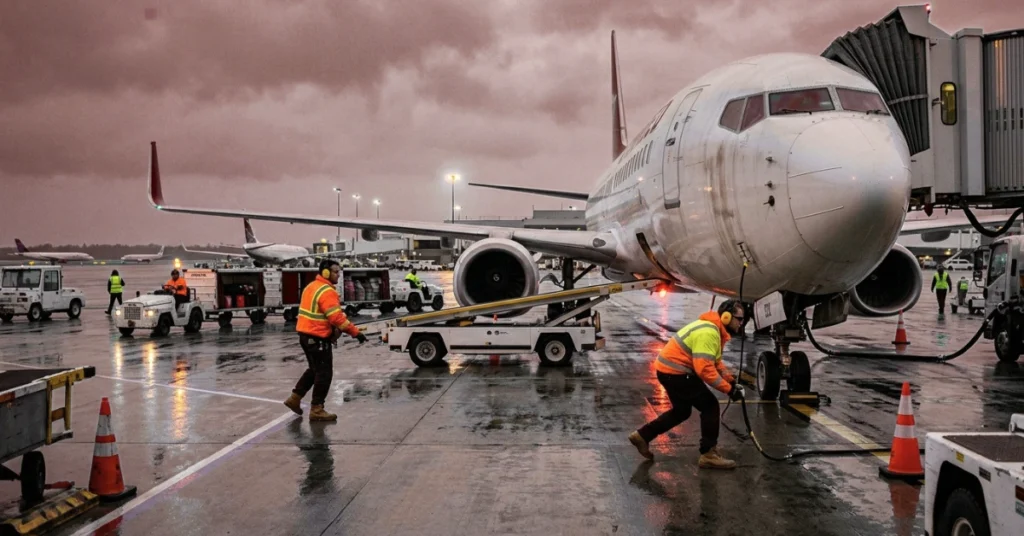
To operate successfully in 2026, you must look past the market potential and confront the ground realities.
Permit Complexity and Processing Variability
African airspace permits are notoriously variable. Lead times and documentation requirements differ not just by country, but by the specific official on duty. Some West African states require Note Verbale (diplomatic clearance) on top of standard CAA permits, adding days of coordination. Missing a local holiday on your planning calendar can result in a missed processing window for the entire routing. For a comprehensive framework on managing permit complexity in African and other complex markets, Aeroworld’s overflight permit consequences guide details exactly what happens when the permit process fails — and how to prevent it. The ICAO Africa Regional Office provides baseline guidance on regional permit frameworks.
Fuel Availability and Reliability
Jet A-1 availability at secondary airports is never a guarantee. Supply chains are thin and quality holds — where fuel is taken out of service due to testing failures — are frequent. In 2026, global disruptions have seen fuel prices spike significantly in some landlocked markets. Operators must have contingency routing that does not rely on a single station for uplift. Aeroworld’s fuel uplift planning guide covers the full framework for managing fuel supply risk across complex international routes. JIG (Joint Inspection Group) standards define the quality assurance baseline that operators should require from every African fuel supplier.
Ground Handling Variability
IATA ISAGO accreditation is far from universal across African stations. While major hubs are well-equipped, secondary stations often lack specialised GSE, ULD equipment, or dangerous goods (DG) certification. Never assume a station can handle your specific cargo type without individual confirmation. For a full framework on what to confirm before sending an aircraft to a challenging station, Aeroworld’s ground handler checklist for international operators covers every pre-arrival confirmation requirement in detail.
Customs and Regulatory Friction
Customs processing remains a significant bottleneck. A well-documented pallet may clear in hours at one port and be held for days at another due to shifting local interpretations of import duties or restricted commodity lists. The World Customs Organization’s Africa regional guidance provides the regulatory baseline — but the gap between published standards and operational reality at secondary African stations requires local intelligence, not just documentation compliance.
Cargo Types That Require Special Preparation
Perishables
A six-hour delay at a station without cold storage can write off an entire shipment. Research confirms that limited cargo capacity in Sub-Saharan Africa directly suppresses the region’s ability to scale high-value agricultural exports — making cold chain continuity at every handling point a commercial as well as an operational requirement. Operators must confirm cold chain capability at every transit stop, not just at origin and destination.
Pharmaceuticals
IATA CEIV Pharma certification is the gold standard for pharmaceutical air cargo handling, but few African handlers hold it outside the major hubs. Nairobi is a notable exception — Kenya Airways Cargo’s CEIV-certified facility represents the benchmark that operators should seek at every station handling pharmaceutical cargo. Operators must map the chain of custody from shipper to consignee and confirm certification status at every handling point, not assume it from hub reputation alone.
Dangerous Goods (DG)
African states often impose restrictions beyond IATA Dangerous Goods Regulations (DGR) standards. Every station’s ability to accept, store, and load DG cargo must be verified individually. A DG certification gap discovered at departure cannot be resolved at departure.
Project Cargo
Heavy infrastructure pieces require cranes or specialised forklifts that may not be present at the destination. Always verify ramp dimensions and PCN (Pavement Classification Number) limits before committing a wide-body freighter to a new African route. The weight of a fully loaded B747F or B777F can exceed the PCN of regional runways that are not published as weight-restricted.
Regulatory and Permit Preparation — The African-Specific Framework

In African permit processing, the safest assumption is that the most complex requirement in your routing sets the timeline for the entire trip. Aeroworld’s permit management framework is built specifically around this principle — simultaneous applications, relationship-based authority engagement, and amendment pre-positioning as standard practice.
Longest lead time planning
If a five-country routing has one state requiring 7 working days for diplomatic clearance, the entire mission must be planned on that 7-day timeline — not averaged across the faster-processing states. Submit all applications simultaneously to account for varying response speeds.
Relationship-based management
Self-managed applications to African CAAs consistently produce slower processing and higher rejection rates than applications made through operators with established working contacts at those authorities. The ICAO ESAF Regional Office provides the formal framework — but the operational reality is that relationship management at the authority level is what determines processing speed.
Pre-position for amendments
Cargo manifests and schedules change frequently. In Africa, an amendment can take as long as the original application at certain authorities. Build an amendment buffer into every operational timeline — not just the initial application window.
Building a Reliable Operational Network in Africa

To move from a one-off charter to a consistent operation, you need more than an aircraft — you need an ecosystem.
Local partner relationships are non-negotiable
Aviation in Africa operates on relationships in ways that more institutionalised markets do not. A local partner who knows the customs officer, can flag a fuel shortage 24 hours before arrival, or has a working relationship with the airport authority duty manager is your real operational infrastructure — not the handler directory entry.
Airport authority engagement
Friction in African cargo operations often occurs at the airport authority level — parking stand allocation, ramp access timing, cargo storage assignment — rather than at the handler level. Understanding this distinction is key to avoiding delays that appear to be handler failures but are actually authority coordination failures.
Crew logistics
Do not assume crew accommodation or secure transport is available at secondary African stations. Crew welfare and verified secure transport must be pre-arranged before departure — not treated as a station arrival task. For operations into Libya and Gambia specifically, where Aeroworld has direct presence, crew logistics are managed as part of the integrated ground operations brief.
How Aeroworld Supports Cargo Operators Entering African Markets
Aeroworld provides ground-level intelligence and operational support across African markets that remote agencies cannot replicate.
Direct presence in North and West Africa
With offices in Tripoli, Libya and established operations in The Gambia, Aeroworld offers genuine physical presence in markets where on-the-ground relationships are the operational infrastructure. For operators entering these markets, the Aeroworld Libya and Gambia operational experience represents the kind of station intelligence that only comes from operating there directly — not from a database updated 18 months ago.
Permit expertise across African CAAs
Aeroworld’s permit management team maintains direct lines to CAAs across the continent, facilitating faster clearances for complex routings through states that require diplomatic coordination, simultaneous multi-country applications, and real-time amendment management when cargo schedules change.
Fuel and handling management
Aeroworld manages fuel releases and vets ground handlers specifically for cargo capabilities — including cold chain, DG certification, and ULD handling — across its African network. Operators benefit from pre-confirmed supply arrangements at stations where spot purchasing is unreliable.
Integrated cargo and flight support
Because Aeroworld handles permits, flight planning, fuel, and ground coordination as a single integrated function, cargo stop changes — which are frequent in African operations — are managed as coordinated updates, not as cascading independent amendments that lose synchronisation with each other.
Africa is not a market to enter with optimism and no preparation. It is a market to enter with the right partner already in place.
Conclusion
African air cargo demand in 2026 is driven by structural forces — e-commerce, pharmaceuticals, and agricultural growth — that are here to stay. African airlines achieved their strongest monthly growth in January and February 2026, and industry consensus points to stable-to-positive growth continuing through the year despite geopolitical headwinds elsewhere. The operators who capture this growth are not those who move the fastest, but those who prepare most thoroughly.
The gap between a successful African cargo operation and a grounded one is almost always the depth of operational preparation — permits filed with sufficient lead time, fuel confirmed rather than assumed, handlers vetted for cargo-specific capability, and a local partner with on-the-ground intelligence already in place.
Moving cargo into or across Africa and need operational support from a team already in the market? Aeroworld’s cargo and flight support teams cover permits, fuel, handling, and ground coordination across African stations. Contact us at aeroworld.pk or reach our ops team 24/7 at +92 315 6666772.
Frequently Asked Questions
Q1: Which African airports have the strongest cargo infrastructure in 2026?
Nairobi (JKIA), Addis Ababa (Bole), Johannesburg (OR Tambo), Lagos (MMA), and Accra (KIA) remain the primary cargo-capable stations. Even these hubs face peak-time capacity constraints — Nairobi’s CEIV-certified pharmaceutical facility represents a significant infrastructure investment but serves a specific cargo segment. For secondary airports across West and North Africa, individual capability confirmation is essential. Many are still upgrading cargo storage and ramp lighting. Operator assessments should be based on current confirmation, not directory listings that may be 12–18 months out of date.
Q2: What permits are required for a non-scheduled cargo flight into an African country?
In addition to standard overflight and landing permits, many African states require a cargo-specific permit for non-scheduled foreign freighter operations. In West and Central Africa, diplomatic clearances (Note Verbale) are often required on top of CAA permits. Lead times range from 48 hours to over 7 working days — and local public holidays can pause processing across the entire routing simultaneously. For a detailed breakdown of what happens when permits fail and how to prevent it, see Aeroworld’s overflight permit consequences guide.
Q3: Is cold chain cargo viable through African airports?
It is viable at major hubs with dedicated infrastructure — Nairobi’s Kenya Airways CEIV-certified facility is the regional benchmark, while Addis Ababa and Johannesburg also offer established cold chain handling. At secondary stations, cold chain continuity is not guaranteed. IATA CEIV Pharma-certified handlers are limited outside the primary hubs. Operators must map the journey station-by-station and confirm that temperature-controlled storage and GSE are functional and available before departure.
Q4: What are the most common causes of cargo delays at African airports?
The primary causes are customs documentation errors, fuel supply disruptions at secondary airports, permit processing delays compounded by public holidays, and ground equipment unavailability such as a broken high-loader or unavailable ULD equipment. Research by TIACA and Pharma.Aero confirms that capacity constraints and handling limitations at secondary stations are systemic — not exceptional events. Most of these delays are preventable with thorough pre-departure vetting and local representation.
Q5: How does AfCFTA affect air cargo operations in Africa?
AfCFTA is stimulating intra-African trade and creating new demand for regional city-pairs — Dakar to Abuja, Harare to Nairobi, Douala to Lagos. While it progressively reduces tariff barriers, it has not yet standardised customs procedures across member states. Operators should not assume “reduced tariffs” means “simplified customs” — local regulations and procedures still vary significantly by station and by commodity type. Industry consensus is that AfCFTA’s trade connectivity gains will increasingly be realised through air cargo as intra-African trade volumes grow through 2026 and beyond.
Q6: What aircraft types are most suitable for African cargo operations?
Narrow-body freighters such as the B737F or A321F are the most versatile for secondary African airports — they provide meaningful cargo capacity without the infrastructure requirements of wide-body operations. Wide-body freighters (B777F, B747F) are appropriate for major hub operations at Nairobi, Addis, Johannesburg, and Lagos where the infrastructure supports them. At secondary airports, the PCN of runways and taxiways may not support wide-body MTOW — always verify runway and taxiway load limits before committing a wide-body to a new African route. For remote or short-field operations, turboprop freighters offer access that jet equipment cannot provide.
Q7: Does Aeroworld handle cargo operations directly or through sub-agents in Africa?
Aeroworld operates directly in Libya (Tripoli) and The Gambia — these are genuine on-the-ground operational presences, not sub-agent arrangements. For operations at these stations, Aeroworld’s team has established relationships with airport authorities, CAAs, fuel suppliers, and customs officials built from direct operational experience. Across the broader African network, Aeroworld works with a vetted partner network selected for operational track record and existing authority relationships — not lowest cost. This combination of direct presence and verified network provides station-level intelligence that remote agencies cannot replicate.