Beyond the Hype: The Operational Reality of Sourcing SAF for Global Flights
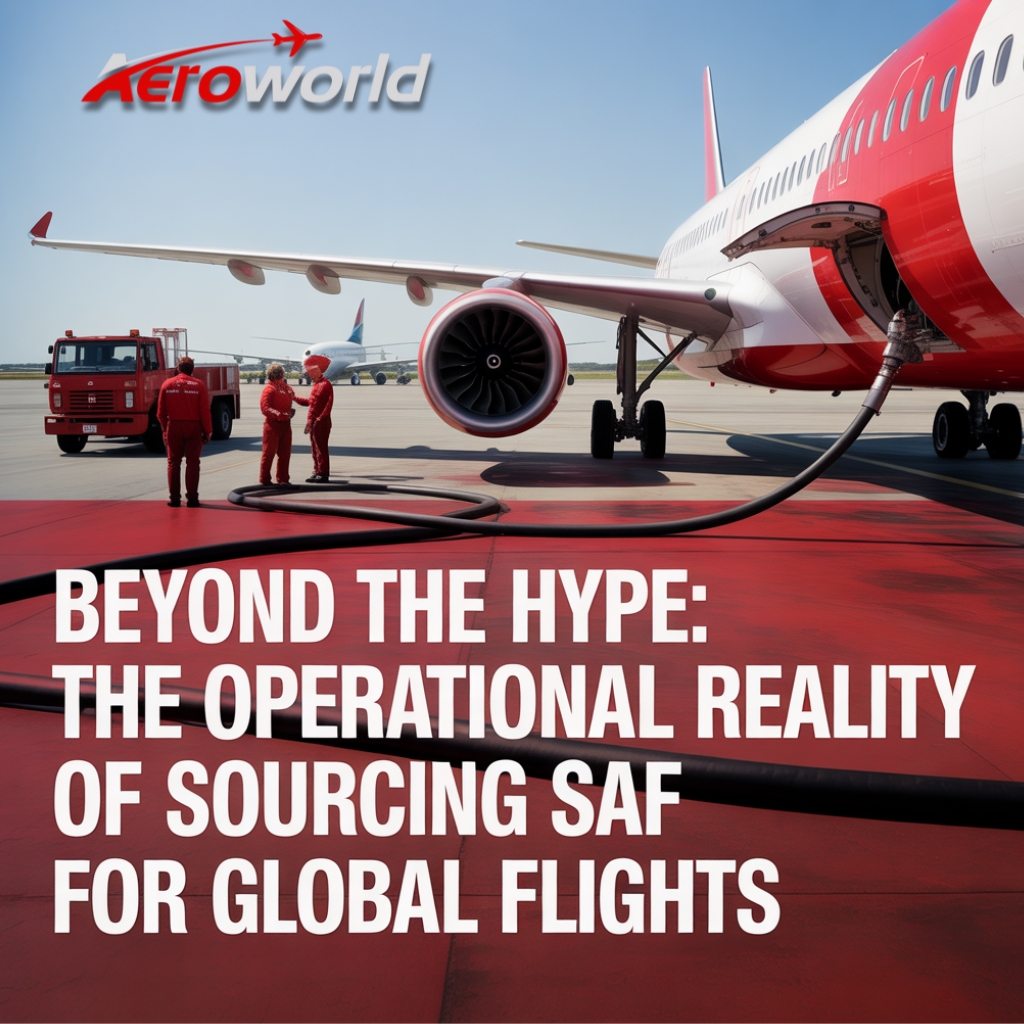
The aviation industry stands at a critical crossroads. While flight remains the lifeblood of global commerce and connection, its environmental footprint is under intense scrutiny. With a global commitment to reach net-zero emissions by 2050, the sector is looking toward a singular, powerful solution: Sustainable Aviation Fuel (SAF). However, the transition from fossil-based kerosene to sustainable alternatives is not just a matter of chemistry it is a monumental challenge of economics, infrastructure, and international policy. Currently accounting for less than 0.1% of global jet fuel, SAF must scale rapidly to meet 65% of the industry’s needs within the next three decades. In this report, we break down the high costs, supply chain bottlenecks, and the next-generation technologies like Power-to-Liquid (PtL) that are essential for taking aviation into a carbon-neutral future. The Indispensable Role of SAF in Net-Zero The global aviation sector, responsible for roughly 2.5% of annual global emissions, faces a formidable challenge: achieving net-zero emissions by 2050 [IATA, 2021 Resolution]. This ambitious target rests almost entirely on the shoulders of Sustainable Aviation Fuel (SAF). The global aviation sector, responsible for roughly 2.5% of annual global emissions, faces a formidable challenge: achieving net-zero emissions by 2050 [IATA, 2021 Resolution]. This ambitious target rests almost entirely on the shoulders of Sustainable Aviation Fuel (SAF). Despite its unequivocal promise, a significant gap persists between ambitious climate mandates and operational reality. While the industry needs Sustainable Aviation Fuel to constitute over 65% of its fuel mix by 2050, Sustainable Aviation Fuel Challenges currently accounts for less than 0.1% of global commercial jet fuel use [IATA, 2024 Market Data]. Global production capacity reached approximately 1 million metric tons in 2024 [ResourceWise, 2024 Report], marking impressive growth but still only covering a tiny fraction of demand. Economic Barriers: High Cost and Investment Risk The most immediate and profound constraint on Sustainable Aviation Fuel scaling is economic. Prohibitive Cost Premium and Market Stalemate SAF remains 2 to 5 times more expensive than conventional jet fuel [Argus Media, Price Analysis]. For airlines, where fuel already constitutes a staggering 20–30% of operating costs, this premium is prohibitive without regulatory intervention. In 2022, the average SAF price was estimated at around USD 2,400 per ton, roughly two and a half times the price of conventional jet fuel at the time [IATA, Economic Reports]. This cost differential has created a classic “chicken-and-egg” investment cycle: Producers need multibillion-dollar investments but cannot secure financing without long-term commitments; airlines cannot commit to multi-year contracts at current high prices. Monetizing Carbon: The Role of Policy Intervention Breaking this stalemate requires monetizing the carbon abatement value of SAF. Targeted policy mechanisms are essential: Verification Challenges in Book & Claim Systems “Book & Claim” systems are emerging to simplify logistics and financial transfer. A carrier purchases the certified carbon reduction credit (the Book), while the fuel is physically used by a different carrier near the production site (the Claim). While this facilitates investment, it heightens complexity in verification and auditing to prevent double-counting. Supply Chain Bottleneck: Feedstocks and Logistics HEFA Dominance and the Feedstock Competition Crisis Scaling Technology: The Shift to Next-Generation Fuels Achieving the massive scale required by 2050 demands pivoting investment to next-generation technologies. 1. Power-to-Liquid (PtL): The Zero-Emission Goal PtL is the ultimate goal, offering a path to nearly zero-emission fuel not constrained by biomass. 2. Other Scalable Pathways: AtJ and BtL Policy Frameworks: US vs. EU Case Studies The lack of a unified global policy framework is a major impediment. The EU: Driving Compliance Market Demand (ReFuelEU) The EU’s ReFuelEU Aviation initiative sets mandatory blending obligations for fuel suppliers. The US: Supply-Side Stimulation (IRA Tax Credits) The US approach, driven by the Inflation Reduction Act (IRA), focuses on supply-side stimulation through tax credits. Conclusion: The Long Runway to Commercial Reality Sustainable Aviation Fuel is the indispensable core of aviation’s net-zero future. The challenges of high cost, HEFA dependency, and logistical fragmentation are structural and interconnected. The long-term viability of global flight hinges on the collective, decisive action taken now to finance and accelerate next-generation technologies. Clear and stable regulatory frameworks must be globally harmonized to provide the investment certainty required to transform this costly, complex product into an essential commercial reality. Frequently Asked Questions What is Sustainable Aviation Fuel (SAF)? Sustainable Aviation Fuel is a clean alternative to traditional fossil-based jet fuel. It is produced from renewable resources such as used cooking oil, agricultural waste, or even captured carbon and green hydrogen. Because it is a “drop-in” fuel, it can be blended with conventional kerosene and used in existing aircraft engines without any modifications. Why is SAF Important for Net-Zero 2050? Aviation is one of the “hard-to-abate” sectors because electric and hydrogen-powered planes are not yet viable for long-haul flight. Experts estimate that SAF will need to contribute around 65% of the total carbon reductions required for the industry to reach its goal of net-zero emissions by 2050. Why is SAF So Expensive Compared to Regular Jet Fuel? Currently, SAF is 2 to 5 times more expensive than conventional jet fuel. This is due to the limited availability of raw materials (feedstocks), the high cost of specialized production facilities, and the fact that the industry is still in its early stages without the benefit of large-scale production. What is the Power-to-Liquid (PtL) Pathway? Power-to-Liquid, often called e-fuel, is a next-generation technology that creates fuel by combining green hydrogen with captured carbon dioxide. Unlike bio-based fuels, PtL is not limited by the availability of waste oils or crops, making it the most scalable long-term solution for zero-emission flight. How are Governments Helping Scale SAF Production? Governments are using two main strategies: the EU uses “Blending Mandates” (ReFuelEU) to force a certain percentage of SAF use, while the US uses “Tax Credits” (Inflation Reduction Act) to make SAF production more profitable for companies. Both approaches aim to reduce the price gap and encourage investment. Fueling the Future of Aviation! Connect with Aeroworld to learn how we are supporting the transition to Sustainable Aviation
Beyond the Runway: How Ground Handling Excellence Shapes Passenger Experience
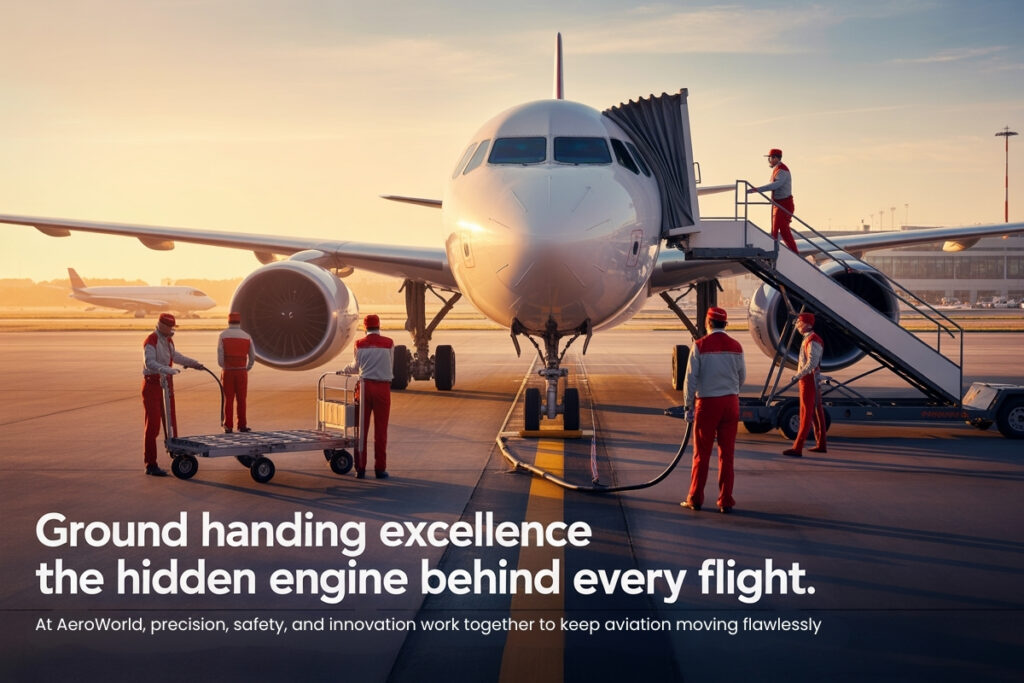
When we think of aviation excellence, our minds usually soar to 30,000 feet—focusing on sleek cabin interiors, gourmet catering, and the thrill of the destination. Yet, the true foundation of every successful flight is laid long before the wheels leave the tarmac. Ground handling is the “unseen backbone” of the industry. It is a high-stakes choreography of fueling, loading, safety checks, and precision timing where every minute saved translates directly into operational revenue and passenger trust. At Aeroworld, we view ground operations not merely as a technical necessity, but as a critical brand touchpoint. From the digital coordination of predictive analytics to the rigorous safety standards of IATA, ground handling is where operational efficiency meets the passenger’s peace of mind. In this exploration, we dive into the mechanics of the “invisible engine” and explain why excellence on the ramp is the ultimate differentiator in modern aviation. The Unseen Backbone: Why Ground Handling Excellence is Foundational When passengers step aboard, they often think of the cabin, the service, and the destination ahead. What they don’t see is what happens behind the scenes and that’s where excellence truly begins. Ground handling the suite of services that support an aircraft while it’s on the ground is the invisible engine behind every seamless journey. From marshalling the aircraft into its stand to fueling, cleaning, loading baggage, supporting the crew and catering, each minute counts. Because every minute an aircraft stays on the ground is a minute it’s not generating revenue, and more importantly, a minute in which the passenger’s experience is waiting to begin. Measuring Success: The Foundational Role of Ground Operations While “on-time departure” is the visible metric, the unseen work of ground handling underpins that outcome. Ground handling encompasses ramp operations (aircraft docking, marshalling, push-back), baggage and cargo handling, refueling, cleaning, catering, crew services, and many other functions. In business and charter aviation (GlobalAir), where every minute and every detail is magnified, the ground handling team becomes a partner in the brand’s promise of reliability and comfort. A delayed turnaround, missing baggage, or poorly coordinated crew service can quickly undermine the high value experience that operators and passengers expect. Critical KPI: Optimizing Aircraft Turnaround Time (ATT) From a commercial‐aviation perspective, too, each minute of turnaround time (TAT) influences aircraft utilization, crew scheduling, slot performance, and ultimately cost per flight. According to KPI-Depot, “Aircraft Turnaround Time (ATT) is a critical KPI, High ATT values indicate inefficiencies, ideal targets typically fall below 30 minutes for narrow-body aircraft and 45 minutes for wide‐body aircraft.” In short: ground handling is not ancillary, it is foundational. The difference between a scheduled departure and a frustrated passenger often comes down to what happens on the ramp. Ground Handling: Elevating Operational Efficiency to a Brand Experience Once considered purely operational and behind-the-scenes, ground handling is increasingly being recognized as part of the brand experience. Airlines, charter companies, and private aviation operators are realizing that the moment passengers step onto the ramp or taxi into the stand, their perception begins to form. At major industry events such as NBAA Business Aviation Convention & Exhibit, EBACE and MEBAA Show, ground operations and handling quality are increasingly highlighted as differentiators not just for safety or cost, but for passenger satisfaction, reliability, and brand promise. When your ground-handling partner consistently delivers fast turnarounds, safe operations, clear coordination, and professional crew support, the operator’s reputation for reliability is reinforced. Conversely, poor handling elevates risk and undermines brand trust. Driving Ground Handling Excellence with Technology and Training The days of clipboards and stopwatch-timed marshalling are over. Today’s ground handling must combine human expertise, rigorous training, and sophisticated technology to meet the demands of safety, efficiency and passenger expectations. Smart Systems and Digital Coordination for Predictive Ground Ops One of the biggest shifts in ground operations is the integration of digital tools. For example, Honeywell offers a mobile application specifically for ground handlers that tracks each task of aircraft turnaround (fueling, catering, cleaning, boarding) and provides airline or ground-operations teams a real-time status of whether an aircraft is likely to push back on time. More broadly, AI-powered platforms and predictive analytics are enabling ground teams to monitor resource bottlenecks, visualize movements of GSE (ground support equipment), optimize ramp vehicle routing, and forecast delays before they cascade. These systems help reduce what was once a reactive process into a predictive one enabling ground-handling supervisors to make decisions in real time, allocate equipment proactively, and keep aircraft turnaround on schedule. Safety Metrics and Operational Precision: Speed vs. Risk Efficiency cannot come at the cost of safety. Modern ground ops embed safety metrics and performance monitoring alongside time metrics. For example: Certification and Continuous Learning: The Human Element of Excellence Technology and metrics matter but so do people. Aeroworld invests heavily in specialized training and certification programs. Examples include: Simulation-based drills and recurrent training: Aeroworld conducts regular ramp audits, GSE operator refresher courses, and scenario-based exercises (irregular operations, diversion, off-schedule turnarounds) to keep performance sharp. By combining structured certification with practical, real-world drills, Aeroworld’s ground-handling teams maintain both the mindset and the muscle of precision. The Psychology of Predictability: Linking Ground Excellence to Passenger Trust It’s easy to view ground handling as a purely technical function. But for the passenger and for the crew it is a vital touchpoint in the journey, with psychological as well as operational implications. From Efficiency to Emotion: Building Trust Through Competence Passengers rarely think about fuel trucks, cargo loaders or GSE tractors. What they feel is the result: Did the flight depart on time? Did my baggage arrive? Was my boarding smooth? Was the aircraft ready and comfortable? When ground-handling operations are tight and professional, passengers sense reliability and competence. They feel less anxious. They trust that the operator cares about the details. That trust becomes a positive part of the brand experience. Conversely, delays, mishandled baggage, chaotic boarding or crew that seems rushed can raise anxiety levels, erode confidence, and negatively color the entire travel segment. In business or charter aviation especially, where clients value time, comfort