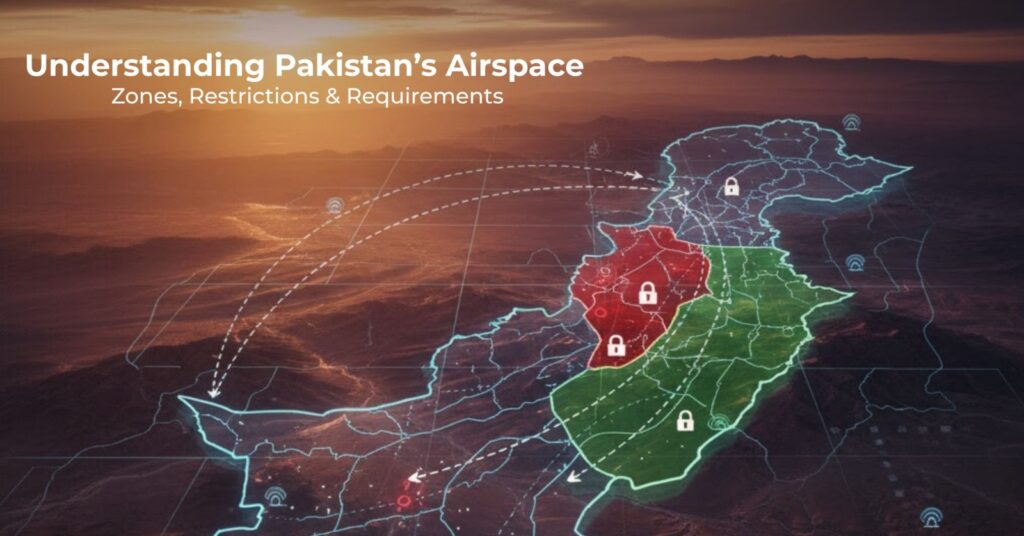
Pakistan’s airspace plays a critical role in regional and international aviation, acting as a key corridor connecting the Middle East, South Asia, Central Asia, and East Asia. For international operators, business aviation teams, and cargo carriers, understanding how Pakistan’s airspace is structured and what rules govern it is essential for safe, compliant, and efficient flight operations.
This guide provides a clear overview of Pakistan’s airspace structure, FIR divisions, restricted and controlled zones, operational requirements, and practical tips to help operators navigate Pakistani airspace smoothly.
Overview of Pakistan’s Airspace Structure
Pakistan’s airspace is managed and regulated by the Pakistan Civil Aviation Authority (PCAA) in accordance with ICAO standards. The airspace is structured to ensure:
- Safe separation of aircraft
- Efficient traffic flow
- Secure management of civil and military operations
- Compliance with international aviation regulations
Like most ICAO member states, Pakistan divides its airspace into controlled, restricted, prohibited, and military zones, each with specific operational rules. These classifications help air traffic controllers manage aircraft movements while safeguarding sensitive areas.
Understanding these categories is crucial for flight planning, especially for foreign operators unfamiliar with local procedures.
The Two FIRs: Karachi FIR and Lahore FIR
Pakistan’s airspace is divided into two major Flight Information Regions (FIRs), each responsible for air traffic services within its designated boundaries.
Karachi FIR
The Karachi FIR covers:
- Southern Pakistan
- The Arabian Sea coastal region
- Major international routes connecting the Middle East and South Asia
Key airports under Karachi FIR include Jinnah International Airport (OPKC) and several important alternate and military airfields. This FIR handles a high volume of international overflights, cargo traffic, and long-haul operations.
Lahore FIR
The Lahore FIR covers:
- Northern and central Pakistan
- Airspace near borders with India, Afghanistan, and China
- Routes associated with regional and domestic traffic
Major airports include Allama Iqbal International Airport (OPLA) and Islamabad International Airport (OPIS).
Key Differences
- Karachi FIR manages heavier oceanic and long-range traffic
- Lahore FIR deals more with regional, domestic, and mountainous operations
- Terrain, weather patterns, and traffic density vary significantly between the two FIRs
Operational Boundaries
The boundary between the FIRs is clearly defined in Pakistan’s Aeronautical Information Publication (AIP). Pilots must strictly adhere to FIR-specific ATC instructions when crossing these boundaries.
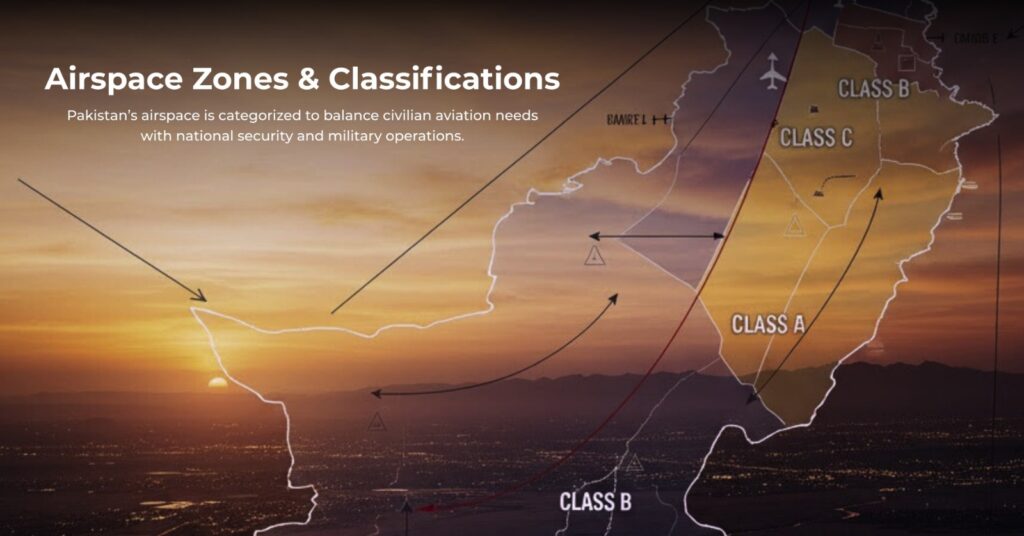
Airspace Zones & Classifications
Pakistan’s airspace is categorized to balance civilian aviation needs with national security and military operations.
Controlled Airspace
Controlled airspace includes Class A, C, D, and E airspace, where:
- ATC clearance is mandatory
- Continuous communication with ATC is required
- IFR flights are strictly monitored
Most commercial and international flights operate entirely within controlled airspace to ensure safe separation and standardized traffic management.
Restricted Areas
Restricted areas are zones where flight operations are limited or conditional due to:
- Military training
- Security concerns
- Sensitive installations
Aircraft may enter restricted areas only with prior authorization and within approved time windows.
Prohibited Zones
Prohibited areas are strictly no-fly zones, usually located over:
- Strategic government facilities
- High-security military installations
- Sensitive national infrastructure
Unauthorized entry into prohibited zones can result in serious regulatory and security consequences.
Military Zones
Military zones may overlap with restricted airspace and are actively used by the Pakistan Air Force. These zones are dynamic, meaning activation times can change based on operational needs. NOTAMs play a crucial role in informing operators about active military areas.

Permits & Approvals Required for Certain Zones
Not all flights require special permits, but specific operations do, including:
- Overflight permits for non-scheduled foreign aircraft
- Landing permits for charter, cargo, and private aviation
- Diplomatic clearances for state and military aircraft
- Special approvals for restricted or military zones
Applications must be submitted within prescribed timelines and must align with PCAA requirements. Missing or incorrect documentation can lead to delays, rerouting, or denial of access.
Weather Patterns Affecting Airspace Operations
Pakistan’s diverse geography creates varying weather challenges across its airspace.
Key weather factors include:
- Monsoon season (July–September) causing thunderstorms and heavy rainfall
- Fog and low visibility during winter, especially in Lahore and Islamabad regions
- Mountain wave turbulence in northern areas
- Dust storms in southern and western regions
Weather conditions can directly affect route availability, altitude selection, and fuel planning. Operators should always review METARs, TAFs, SIGMETs, and NOTAMs before flight.
Navigation, ATC & Communication Requirements
Pakistan employs modern navigation and surveillance systems aligned with ICAO standards.
Key requirements include:
- ICAO-compliant navigation equipment (VOR, DME, GNSS)
- Continuous two way communication with ATC
- Strict adherence to assigned flight levels and routes
- Compliance with standard phraseology
English is the official language for aviation communication. Controllers are experienced in handling international traffic, but clear and precise communication remains essential.
Tips for Smooth Flight Operations in Pakistani Airspace
To ensure efficient and compliant operations, operators should:
- Apply for permits well in advance
- Monitor NOTAMs closely, especially for restricted areas
- Plan alternates considering weather and terrain
- Maintain flexibility for route or altitude changes
- Coordinate with local aviation experts when unfamiliar with procedures
Preparation is key to avoiding operational disruptions.
How Aeroworld Assists Operators with Airspace Navigation
Aeroworld supports operators by simplifying complex airspace requirements through:
- Overflight and landing permit coordination
- FIR-specific route planning
- NOTAM and weather monitoring
- ATC coordination and compliance checks
- Real-time operational support
With in-depth local knowledge and international aviation expertise, Aeroworld helps operators navigate Pakistan’s airspace with confidence and efficiency.
Pakistan’s airspace is strategically vital and professionally managed, but it requires careful planning and regulatory awareness. From understanding FIR boundaries to navigating restricted zones and weather challenges, informed preparation makes all the difference.
For international operators, partnering with experienced aviation service providers ensures compliance, safety, and seamless operations across Pakistani airspace.