When we think of aviation excellence, our minds usually soar to 30,000 feet—focusing on sleek cabin interiors, gourmet catering, and the thrill of the destination. Yet, the true foundation of every successful flight is laid long before the wheels leave the tarmac.
Ground handling is the “unseen backbone” of the industry. It is a high-stakes choreography of fueling, loading, safety checks, and precision timing where every minute saved translates directly into operational revenue and passenger trust. At Aeroworld, we view ground operations not merely as a technical necessity, but as a critical brand touchpoint. From the digital coordination of predictive analytics to the rigorous safety standards of IATA, ground handling is where operational efficiency meets the passenger’s peace of mind.
In this exploration, we dive into the mechanics of the “invisible engine” and explain why excellence on the ramp is the ultimate differentiator in modern aviation.
The Unseen Backbone: Why Ground Handling Excellence is Foundational
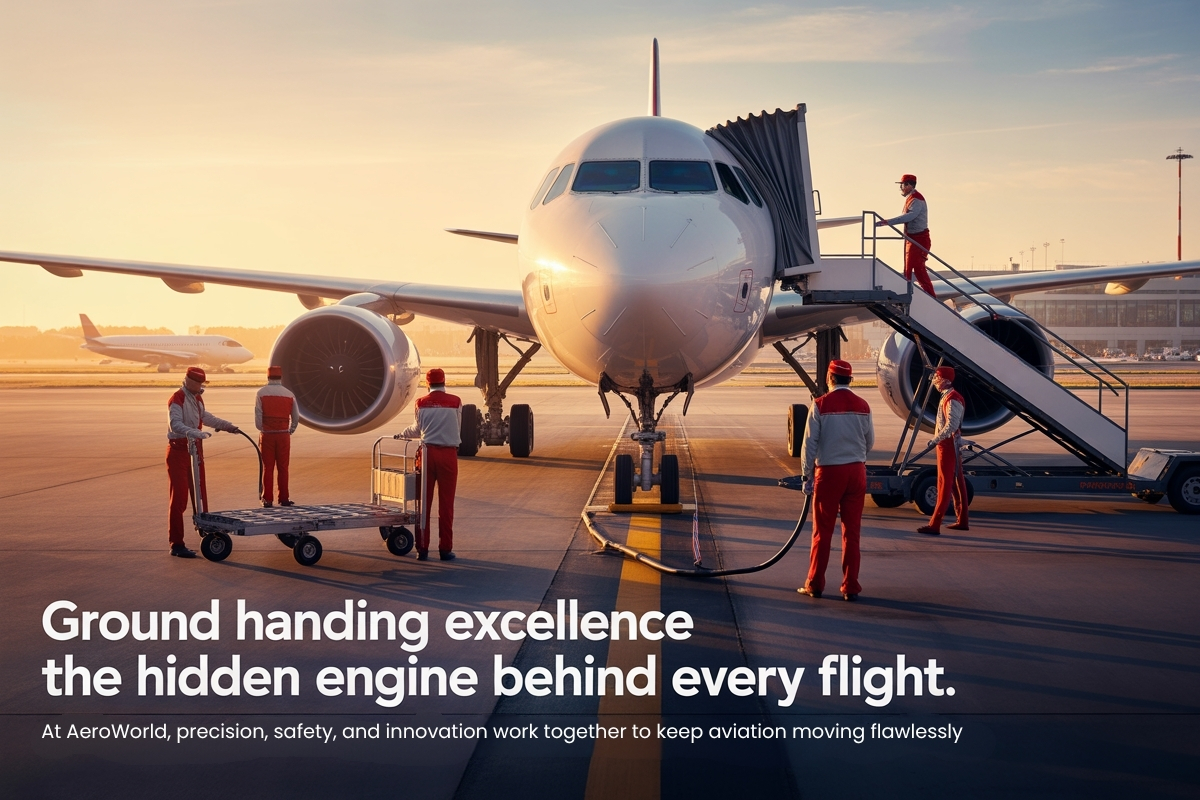
When passengers step aboard, they often think of the cabin, the service, and the destination ahead. What they don’t see is what happens behind the scenes and that’s where excellence truly begins. Ground handling the suite of services that support an aircraft while it’s on the ground is the invisible engine behind every seamless journey.
From marshalling the aircraft into its stand to fueling, cleaning, loading baggage, supporting the crew and catering, each minute counts. Because every minute an aircraft stays on the ground is a minute it’s not generating revenue, and more importantly, a minute in which the passenger’s experience is waiting to begin.
Measuring Success: The Foundational Role of Ground Operations
While “on-time departure” is the visible metric, the unseen work of ground handling underpins that outcome. Ground handling encompasses ramp operations (aircraft docking, marshalling, push-back), baggage and cargo handling, refueling, cleaning, catering, crew services, and many other functions.
In business and charter aviation (GlobalAir), where every minute and every detail is magnified, the ground handling team becomes a partner in the brand’s promise of reliability and comfort. A delayed turnaround, missing baggage, or poorly coordinated crew service can quickly undermine the high value experience that operators and passengers expect.
Critical KPI: Optimizing Aircraft Turnaround Time (ATT)
From a commercial‐aviation perspective, too, each minute of turnaround time (TAT) influences aircraft utilization, crew scheduling, slot performance, and ultimately cost per flight. According to KPI-Depot, “Aircraft Turnaround Time (ATT) is a critical KPI, High ATT values indicate inefficiencies, ideal targets typically fall below 30 minutes for narrow-body aircraft and 45 minutes for wide‐body aircraft.” In short: ground handling is not ancillary, it is foundational. The difference between a scheduled departure and a frustrated passenger often comes down to what happens on the ramp.
Ground Handling: Elevating Operational Efficiency to a Brand Experience
Once considered purely operational and behind-the-scenes, ground handling is increasingly being recognized as part of the brand experience. Airlines, charter companies, and private aviation operators are realizing that the moment passengers step onto the ramp or taxi into the stand, their perception begins to form.
At major industry events such as NBAA Business Aviation Convention & Exhibit, EBACE and MEBAA Show, ground operations and handling quality are increasingly highlighted as differentiators not just for safety or cost, but for passenger satisfaction, reliability, and brand promise.
When your ground-handling partner consistently delivers fast turnarounds, safe operations, clear coordination, and professional crew support, the operator’s reputation for reliability is reinforced. Conversely, poor handling elevates risk and undermines brand trust.
Driving Ground Handling Excellence with Technology and Training
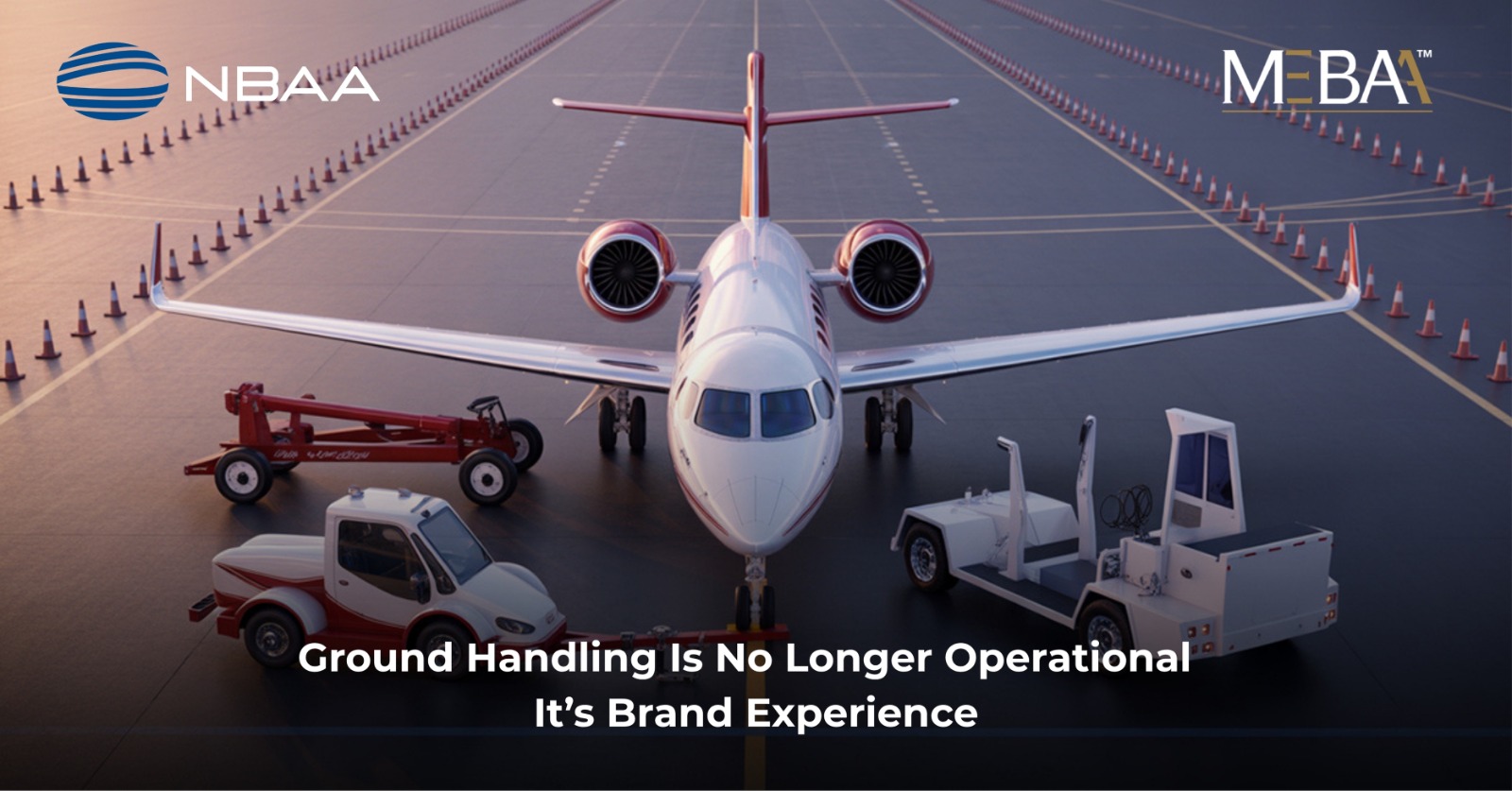
The days of clipboards and stopwatch-timed marshalling are over. Today’s ground handling must combine human expertise, rigorous training, and sophisticated technology to meet the demands of safety, efficiency and passenger expectations.
Smart Systems and Digital Coordination for Predictive Ground Ops
One of the biggest shifts in ground operations is the integration of digital tools. For example, Honeywell offers a mobile application specifically for ground handlers that tracks each task of aircraft turnaround (fueling, catering, cleaning, boarding) and provides airline or ground-operations teams a real-time status of whether an aircraft is likely to push back on time. More broadly, AI-powered platforms and predictive analytics are enabling ground teams to monitor resource bottlenecks, visualize movements of GSE (ground support equipment), optimize ramp vehicle routing, and forecast delays before they cascade.
These systems help reduce what was once a reactive process into a predictive one enabling ground-handling supervisors to make decisions in real time, allocate equipment proactively, and keep aircraft turnaround on schedule.
Safety Metrics and Operational Precision: Speed vs. Risk
Efficiency cannot come at the cost of safety. Modern ground ops embed safety metrics and performance monitoring alongside time metrics. For example:
- Turnaround Time (TAT) or Aircraft Turnaround Time (ATT): the time from block-on to block-off or from arrival to next departure.
- Ramp Incident Frequency Rate (RIFR): tracking collisions, GSE damage or mishandling events.
- On-Time Departure (OTD): the percentage of flights that depart as scheduled, linked in turn to ground-handling performance.
- Vehicle ramp speed limits and equipment proximity controls (for example “$V_{max}$” for vehicle speed near parked aircraft) while specific numeric standards vary by airport, controlling the speed and movement of GSE is a critical part of ramp safety.
- Safety audit compliance for example the IATA Safety Audit for Ground Operations (ISAGO) and IATA Ground Operations Manual (IGOM) frameworks ensure global consistency of ramp-handling standards.
- By linking time metrics with safety metrics, Aeroworld ensures that we are not simply fast, we are fast and safe.
Certification and Continuous Learning: The Human Element of Excellence
Technology and metrics matter but so do people. Aeroworld invests heavily in specialized training and certification programs. Examples include:
- IATA certification such as the AHM (Airport Handling Manual) and IGOM training, which define global best-practice standards for ground operations.
- Aircraft type-endorsement training: different aircraft (for example, wide-body vs narrow-body, business jets vs commercial jets) require specific servicing steps (fueling, catering, lavatory servicing, push-back, GSE compatibility).
- Ramp Resource Management (RRM) or similar courses focus on human factors, coordination, and decision-making in the high-pressure ramp environment.
- Training at Everglades University
Simulation-based drills and recurrent training: Aeroworld conducts regular ramp audits, GSE operator refresher courses, and scenario-based exercises (irregular operations, diversion, off-schedule turnarounds) to keep performance sharp.
By combining structured certification with practical, real-world drills, Aeroworld’s ground-handling teams maintain both the mindset and the muscle of precision.
The Psychology of Predictability: Linking Ground Excellence to Passenger Trust
It’s easy to view ground handling as a purely technical function. But for the passenger and for the crew it is a vital touchpoint in the journey, with psychological as well as operational implications.
From Efficiency to Emotion: Building Trust Through Competence
Passengers rarely think about fuel trucks, cargo loaders or GSE tractors. What they feel is the result: Did the flight depart on time? Did my baggage arrive? Was my boarding smooth? Was the aircraft ready and comfortable?
When ground-handling operations are tight and professional, passengers sense reliability and competence. They feel less anxious. They trust that the operator cares about the details. That trust becomes a positive part of the brand experience.
Conversely, delays, mishandled baggage, chaotic boarding or crew that seems rushed can raise anxiety levels, erode confidence, and negatively color the entire travel segment. In business or charter aviation especially, where clients value time, comfort and privacy, these elements are magnified.
The Psychology of Predictability:
Humans respond positively to predictability. Flight operations that are on-time, orderly and smooth give passengers a sense of control and confidence especially in an environment (air travel) where control is often limited.
Studies show that when travellers perceive the airline and its ground-handling partner as competent, their overall satisfaction increases, even if there are minor delays. The perception of handling excellence acts as a buffer against service disruption.
For Aeroworld’s clients, private operators, charter companies and business-jet users this psychological benefit is significant: you’re not just transporting assets, you’re delivering a trusted premium experience. By ensuring every ground-handling step is planned, coordinated and executed with precision, Aeroworld helps turn what could otherwise be a stressful travel segment into one of calm, confidence and brand reinforcement.
Crew Coordination and Comfort: The Indirect Impact on Service
Passenger experience is also shaped by the crew experience and the crew experience begins on the ground. When ground handling delivers:
- Documentation is ready, permissions and clearances are handled proactively
- Catering is delivered on time, aircraft cabin is cleaned and prepped
- Crew rest and turnaround logistics are smooth and fit for purpose
The cabin crew can then focus on the passenger experience, rather than firefighting or compensating for ground delays. This creates a virtuous cycle: happy crew → better service → satisfied passengers.
Creating Loyalty Through Operational Excellence:
In charter and business aviation, reliability is more than a metric; it’s a promise. Passengers remember the smoothness of their journey far longer than they remember the aircraft or the route. When Aeroworld’s ground-handling performance consistently delivers fast turnarounds, safe operations and coordinated service, we’re building brand loyalty for our clients.
Every on-time departure, every well-handled arrival, every baggage delivered without a hitch becomes a small but cumulative step in reinforcing the operator’s reputation as one that “knows what it takes”. That’s ground handling elevating the entire passenger and crew experience.
Aeroworld’s Commitment to Ground Handling Excellence
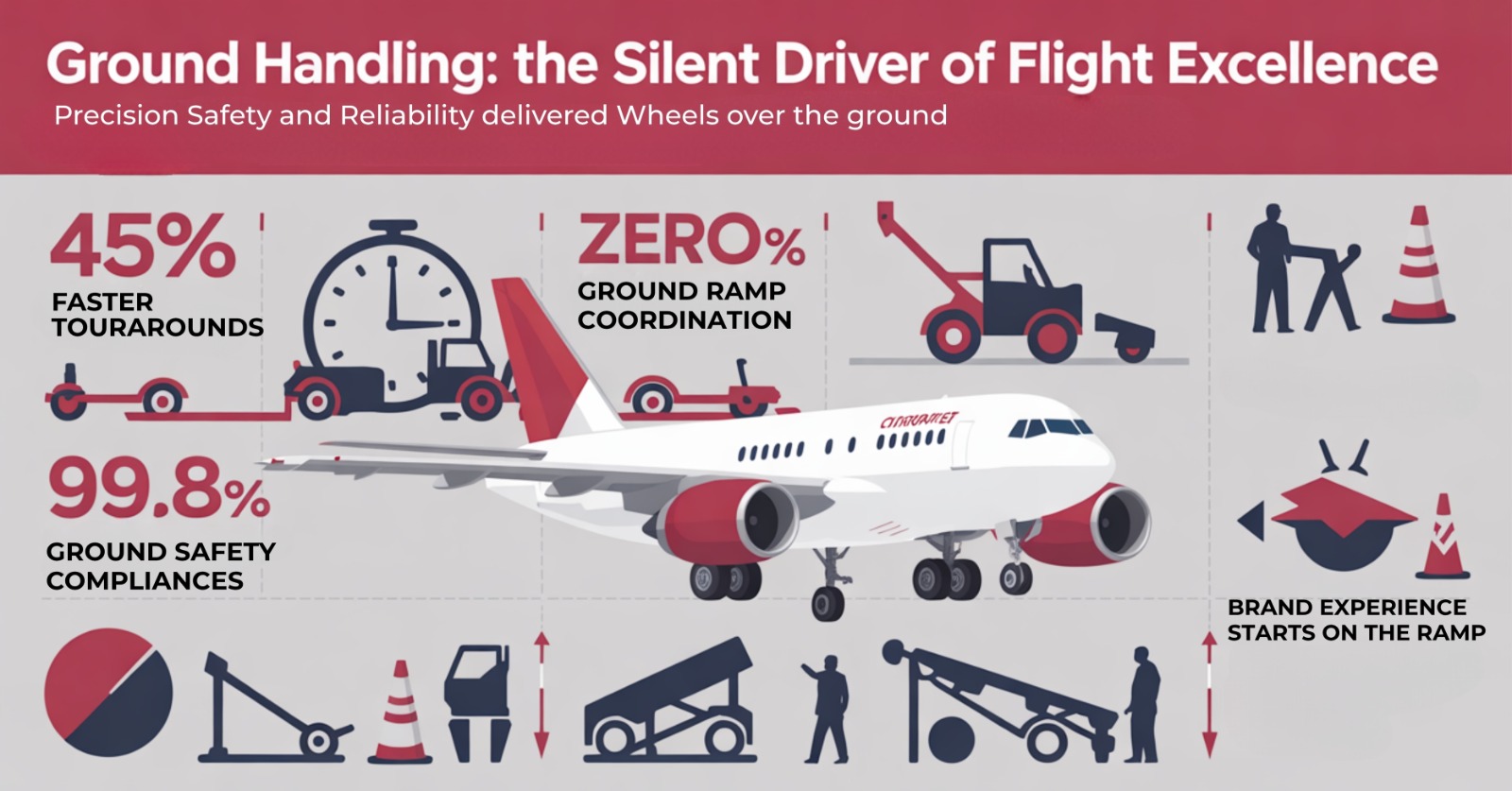
At the heart of Aeroworld’s ground handling service is our operational philosophy: we don’t just move aircraft, we enhance every journey. How we live that out:
- Human expertise + Data-driven planning: Our teams are certified, trained, and equipped with digital tools that monitor operations, flag delays, and support decision-making.
- Safety and performance go hand-in-hand: We measure both time and risk never sacrificing one for the other. Our ramp teams are continuously audited, and we benchmark our KPIs (turnaround time, incident rate, on-time departure) to global best-practice.
- Service as a differentiator: From the moment an aircraft lands to the moment it departs again, our ground teams are part of the passenger and crew experience. Clean cabin, smooth boarding, efficient luggage handling and proactive crew support all contribute to the overall brand promise.
Global footprint, local precision: With operations in multiple regions, we combine global standards (IATA, ISAGO, IGOM) with local knowledge and adaptability. Whether it’s a wide-body commercial jet or a business-jet charter, our teams execute with the discipline of large-scale operations and the finesse of bespoke service.
Conclusion: Beyond the Runway Lies the True Measure of Excellence
Ground handling may remain largely unseen but its impact resonates across every flight. From the moment a jet touches down to the moment it lifts off again, every second counts. At Aeroworld, we understand that excellence on the ground is not just about speed but about safety, reliability and brand integrity.
When technology, training and human expertise come together, the result is operational performance that elevates the passenger and crew experience. And ultimately, in an industry where every minute means something, that hidden engine behind the scenes becomes a visible differentiator in the skies.
Frequently Asked Questions
What is Ground Handling in Aviation?
Ground handling includes all services provided to an aircraft while it is on the ground to prepare it for its next flight. This involves parking the plane, refueling, cleaning the cabin, and loading baggage and catering. It is the essential “behind-the-scenes” engine that ensures every journey starts safely and on time.
Why is Aircraft Turnaround Time (ATT) Important?
Aircraft Turnaround Time is the specific window between a plane landing and taking off again. It is a critical metric because a grounded aircraft does not earn revenue. Ground teams aim for fast, precise turnarounds—often under 30 minutes for smaller jets—to keep schedules on track and maximize operational efficiency.
How Does Ground Handling Impact the Passenger?
Excellence on the ramp creates a “Psychology of Predictability” for the traveler. When ground operations are smooth, passengers experience on-time departures and reliable baggage delivery. This builds deep brand trust and ensures that the crew can focus on service rather than managing delays.
What Standards Govern Global Ground Operations?
To ensure safety and consistency across different airports, ground handling follows international frameworks like the IATA Ground Operations Manual (IGOM). These rules provide a universal language for safety, ensuring that whether a plane is in Dubai or London, the technical and safety protocols remain world-class.
How is Technology Improving Ground Operations?
Modern ground handling uses digital tools and AI to move from reactive to predictive management. Real-time apps track tasks like fueling and boarding as they happen, allowing supervisors to spot potential bottlenecks and solve them before they cause a flight delay.
Experience Ground Handling Excellence!
Partner with Aeroworld to optimize your aircraft turnaround time and elevate your brand’s reliability with our expert ground operations team.
Contact Our Team